Showing posts with label late season bird hunting. Show all posts

Wednesday, October 31, 2018

Wet


     Like it often is late in October, the weather became wet, snow covers the ground in high places, and the sun has remained hidden for days. The only sensible thing to be doing outdoors is hunting, but even that brings into question one’s sanity at a certain point.
     The grouse don’t want to move far from the shelter of softwood trees, but they have to eat. The cold weather requires more calories for them to stay warm. Following the edges of clearcuts we have found a few birds. Too often the birds are a whir of wings with a flash of feathers and gone. The shots are tough, with the softwoods swallowing up the birds in a blink. After almost a month of hunters in the woods, the grouse have seen it all and become skittish.
Maggie is learning every day.
     The dogs still manage to point a few. Maggie, our youngster, is learning stealth, something that is hard to teach and best learned on her own with exposure to wild birds. She does her best after she runs enough to burn off some energy and slow down a bit.
     Today a friend’s setter, Russ, was a delight to watch today as he winded a bird and tiptoed along with his head high. Maggie eventually caught the wafting scent too, but we never found a bird. Was it in a tree laughing at us? Probably, and maybe far ahead across the cutting.
     Up behind a cutting, Russ pointed next to a blowdown. Dave, the dog’s owner, walked in and one bird rocketed low out the far side, offering no shot. Another shot back over his shoulder, but avoided two ounces of ounces of shot he tossed its way.
     Some days are tough, but if it were easy we would soon be bored.
   
 
Cuttings and softwood.


Tuesday, July 31, 2018

Hunting Seasons


The length of ruffed grouse hunting seasons vary from state to state. Some bird hunting seasons run well into the winter, while other states stop much sooner, some even in the fall. A good way to get an argument started in grouse camp is to ask whether late season grouse hunting affects the bird’s population.
Samantha Davis, a University of Maine graduate student, did research with the MDIFW to see how the state’s management of ruffed grouse impacted the population. The results can be seen at the link below. The news is encouraging.


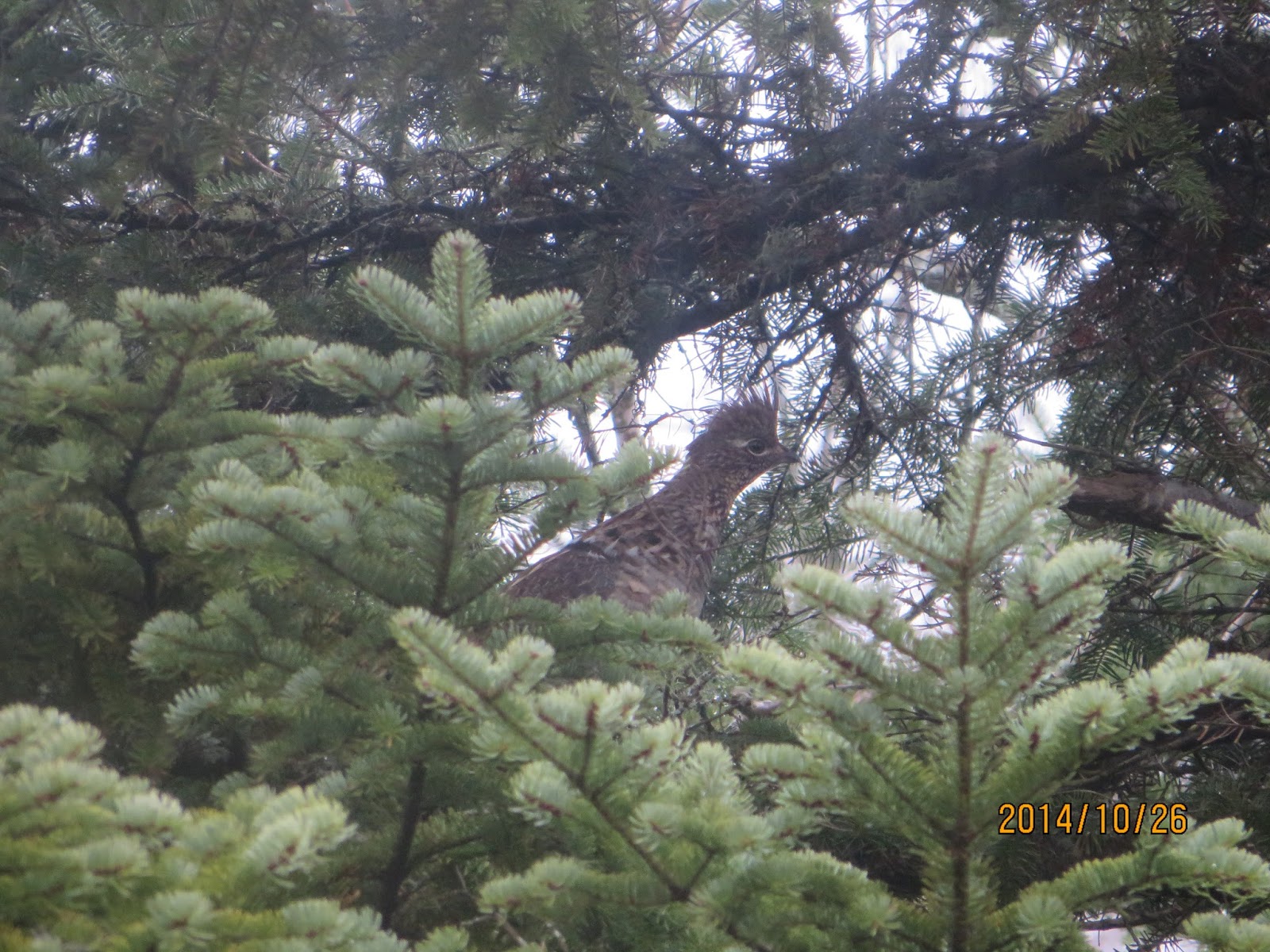
Do you see him in there?

Monday, December 26, 2016

December Grouse

There is a grouse hiding in there.
    In our neck of the woods most of the grouse hunting stops when the deer hunters enter the woods the second week of November, but early in December the riflemen leave the woods to the shotgunners again. The late season can provide of the loveliest hunting of the year or the snow can be so deep the dogs cannot work. Nothing is certain.
    The grouse will be in different cover than October, with most of the fruit gone and snow possibly covering ground covers. Buds and catkins will make up most of their diet, but the birds also eat a variety of green leafy plants if the snow isn’t too deep. Hunting the edges of thick softwood stands usually is productive.
Grouse picking at catkins
    Just like early in the season, often groups are found, frequently up in the boughs of softwood trees. On sunny days they will come down to feed, foraging for whatever they can find or to just soak up the sun on a south facing slope. But when the weather is wet or cold it is easier to retain body heat in the protection of the softwood trees.
    In December it is possible to drive twenty or thirty miles on logging roads and never see another vehicle. Of course you don’t want to have truck troubles when you are fifteen or more miles in the woods by yourself. Keep that in mind and be prepared for a vehicle that might not start.
    A few years back, hunting late in the day in a stand of softwoods long since harvested by the loggers, I stumbled into a covey of grouse that flushed from high in the trees. Most flew across the logging road into a cutting that the previous fall had been waist high weeds with scattered Christmas-tree-sized spruce and firs. By December the weeds had been flattened by rain, frost, and a little snow, so it felt like an open park.
    Almost immediately my dog pointed at the base of a fir. On my approach the bird flew out the back. A minute later the scene repeated, but I went to the left and the grouse to the right. The scenario repeated a couple more times. If there had been someone with me the shooting would have been fantastic, but the grouse were successfully using the trees as shields. Finally, my dog pointed a grouse that had made the fatal mistake of landing in a raspberry patch surrounded by flattened weeds. When the bird thundered up above the brambles into the wide open spaces it was one of the few easy shots one ever gets on grouse.
Chara during a late season adventure.
    But the whole time, in the back of my mind, I kept hoping my truck wouldn’t let me down. It was fourteen miles from there back to the pavement. That weekend I drove over forty-five miles on logging roads and saw only one vehicle, which happened to be a logger.
    When the weather gets bitter many who love ruffed grouse hang up their guns and call it a season to give the birds a break until the next year. Biologists say it doesn’t make a difference in the overall grouse population, but I still can’t harass the birds when conditions are tough. The struggle for calories to maintain body temperature is harsh and one unnecessary flush could be the tipping point in the delicate balance. I prefer to think that a grouse left alive will have a big brood in the spring.
    This year the grouse numbers were down. When the deer hunters left the woods I took the dogs for a few late season hunts, but I’m not sure I would have killed a grouse. The dogs loved wearing their bells again and hunted hard. I carried my shotgun, but never raised it to my shoulder. The few birds we found all flushed from high in softwood trees, with most leaving unseen, and I wished every one of them well.
    The shotgun went into the safe to wait out spring and clay targets.
    Let us hope the grouse survive and the spring weather is kind to the young broods.

Tracks.


Thursday, May 21, 2015

Even Grouseless Days….

    The drive in is about nine miles over a small mountain, across a timber bridge, and then it is then either left further into the wilderness or to the right and another nine or ten miles back out to a different paved road.  We went left.
     About another six miles up the road I parked in the same spot as a month and a half earlier.  The woods looked more open, with the weeds squashed down by snow that had come and gone.  With the naked trees not holding a leaf, the mountains across the valley looked much closer.
    Alders, half again a man’s height, covered an old logging yard there.  Behind them the land climbed gradually, covered with lofty hardwoods and dark old spruce trees.  Below the road young fir trees huddled together like cliques in a school  yard, each separated by open areas of bent and flattened weeds and grass.  Scattered maples and poplar sprouts remained upright, obviously unfazed by the earlier snow.
    Chara, my German wirehair pointer, pranced a few steps from the truck and locked up on point, her nose aimed directly into the nearby alders.  Hurrying shells into my gun, a partridge burst upward and disappeared into the boughs of spruce trees.
    We hunted behind those alders, more or less parallel with the road, and then crossed to the lower side, drifting between the clusters of fir trees.  About the sixth clump Chara’s hind end went into over-drive and then she froze, pointing into a tangle of green needles and gray trunks.   In the dark shadows a boulder poked out of the earth, nothing more. Walking around the left side of the trees, the partridge thundered out of the right, a sound unseen.
    The scenario was played out again, and then again.  Two hunters might have shot some birds.
    Chara slowed and then pointed into a cluster of limby firs. Bright green moss muffled my footsteps.  A partridge that looked the size of a turkey launched under my nose.  Reflexes brought the gun to the shoulder and a finger slapped the trigger, just as the bird ducked around a yellow birch trunk. I’m sure the tree survived. 
     I swear Chara struggled to contain a laugh.
    A bird flushed wild from a thicket of raspberries, and another was pointed on the way back to the truck, but both escaped unscathed.
Unloading the gun and putting it into the truck, I congratulated myself on the valiant conservation effort and the breeding stock that I had left behind.  Chara looked quite proud of herself, as she should with about a half dozen successful points. 
    Another spot further up the road deserved the same treatment.  There, the thick new growth of a fifteen year old clearcut covered the hillside.  Chara plunged in and I followed, as best I could, along wet and lumpy skid trails.  We didn’t find any birds and, if we had, shooting would have been impossible in that thicket.  Eventually our course brought us back out to the logging road about a half mile from the truck. 
    We dropped to the lower side of the road and worked back between the road and a roaring mountain stream.  Nearing the truck Chara’s hind end went into overdrive and, with her nose scouring the ground, she obviously followed a traveling grouse.  The trail went through thick grass, under clusters of young fir trees, beneath a blown down dead fir tree, directly over the top of an automobile-sized boulder, across a log, back into a cluster of waist-high fir trees, and then into raspberries that contained claws like a bobcat. Chara looked determined and optimistic.
    About fifty feet ahead of us, at the edge of the logging road, old Mr. Partridge decided he had enough of those two cahoots following him and took off over the road, to never be seen.
   It was a fitting time to end another memory filled day.


Sunday, January 1, 2012

A Late Woodcock

     Christmas morning my oldest wirehair pointed a woodcock at the edges of the trees beyond the field out behind our home.  She froze rigid so quickly it startled me, it certainly wasn’t expected, and our younger wirehair honored when she spotted her elder.  As I stepped past the dogs the woodcock twittered away through the trees.
     Yesterday morning, New Years Eve day, and in almost exactly the same spot, the scenario played itself out again, with the woodcock picking the same escape route through the forest.
     So far the fall has been mild, but cold weather is forecast for the coming week.  I have to wonder if that woodcock will be able to poke its bill into the ground when it is frozen.


Sunday, December 18, 2011

Oooops!

     About four years ago, my German wirehaired pointer Chara and I left our New Hampshire house walking northwest, more or less parallel with the brook that runs along the bottom of the valley. I knew it would be the last hunt of the season and we had the whole day, so there was no hurry.
     I’d traipsed this same course the year before, so I picked our way carefully.  To the right the land climbs steeply, in places sheer ledge that is almost impossible to go up or down.  A stream the width of a single lane road hurries down the valley to the left, impossible to wade across except in the driest of seasons.  Much of the flat area along the banks is covered with alders and softwood trees, but in a few places the hill comes straight down as ledge to the water’s edge.
     Not far from the house, beneath tall spruce and fir trees, a partridge flushed wild ahead of us.  Chara was younger then and full of enthusiasm, so it may have been her fault, sometimes it is hard to tell. 


     It is excellent bird country there, a plateau covered with softwood trees as big around as my waist, but with openings in the forest that are filled with weeds and leaning alders.  Where the hill rises it does abruptly, hemming one in between it and the stream.  We poked along, crossed an old abandoned beaver dam and then followed a narrow shelf between the water and the hill.
     That shelf ends where ledge plummets into the rushing little river, but a person can carefully climb up a bit and go along the top of the granite face, which we did.  On the other side, the land becomes less steep and is covered with hardwoods, mostly maple and birch, which go down to the stream and uphill to where it’s desperately steep again.  A major game trail crosses there and climbs the hill, the first place that animals have been able to go up the hill at all for almost half a mile.
     Ahead the water takes a turn to the southwest to detour around a large bony knob in front of us, which is covered with spruce that reach for the sky, and one giant white pine that towers to the heavens.  In several places the mound is faced with sheer granite, the largest expanse bending the stream.  We detour inland up into a tight little valley that is blanketed with knee-high ferns that remain boldly green.  It felt like elves should live there somewhere.
     The going was rough, with ground made of barrel-sized boulders covered with slippery moss and all hidden beneath the ferns.  I chose a route up on the hillside some, where the ground was mostly fallen leaves below large hardwood trees.  Chara stayed the course though, hunting the tiny valley’s bottom.
     My mind wandered, taking in the surroundings, and then I noticed Chara was acting birdy as all hell.  I tied to catch up to her, but as I worked downhill the footing became rougher and hurrying proved impossible.  About thirty yards ahead of the dog a grouse flushed from the ferns.
     The valley petered out into a large hollow that ran ninety degrees to our course.  It looked like every other tree there had fallen down, dropped like pick-up-sticks and every which way.  Most were softwoods or poplar, and picking a path through the chaos took time.
     On the far side of that mess, softwood trees grow downhill to the stream and open hardwoods cover the land up the hill to well beyond where one can see.  I chose a course slightly up the slope and through the hardwoods, hoping to find an ancient beaver pond that I’d visited once before.  The softwood/hardwood edge had provided plenty of birds on my previous visit to that country, and at that point I planned to save it for the hunt home.
     After the softwoods of earlier the hardwood stand felt wide open.  I could see a hundred yards or more in every direction, but it sure didn’t look like bird country.  And it wasn’t.  Eventually, a wall of green foliage that ran up and down the hill intercepted our course.
     We entered the softwoods and immediately crossed game trails.  Young birch and poplar mixed in with the conifers.  A moose rub shined on a maple trunk. 
     Chara started to get birdy, sorting out scent, but we never found one. 
     Walking diagonally across the grade, we gradually climbed into woods thick with young poplar, birch, and maple, all no bigger than my forearm.  An old logging road, edged with young softwood trees, slanted across our path and we followed it upward into almost flat country that looked familiar.
     Clusters of fir trees, about the height of a bread truck and not much bigger around, grow where the young hardwoods meet the edge of the old beaver pond.  The pond is more meadow than pond, all silted in and much of it covered with blown down cedar trees, creating an opening in the forest about the size of a football field.  In the center a small puddle remains, not much larger than a residential swimming pool.  Chara started to get birdy again next to one of those clumps of young fir trees, so I watched and waited, gun held at arms.
     A partridge exploded out of a fir next to my right ear.  I barely saw it.  Then a second one burst unseen out the far side of another tree.
Chara still worked the ground, sorting things out, her bell frantically ringing, and I waited.  Where the softwood trees thinned out into hardwoods she locked up like a statue. 
     I started toward her, and then a third bird took off, barely seen and about twenty yards ahead next to a blown down fir tree.
     The far side of the meadow is thick with softwood trees, and I thought about exploring over there and then down to the stream, or maybe hunt right back down the hill to the stream from the closer side of the opening, either of which would have led me to the softwood edge along the stream to follow it toward home.  I suffer from a malady though called “I-wonder-what’s-around-the-next-corner-ism” and, standing there, it pulled me in many directions. 
     It is a disorder that’s sometimes even stronger than my hunting addiction.  Finally, I decided to see how far I was from the top of the hill, which probably was the direction of the least amount of partridge.  But you never know….
     Upward we went, past maples and birch and even some beech trees with their bark like  elephant skin.  It seemed like forever, but I don’t really know how long the trek was.  There weren’t any birds, but I didn’t expect any unless we found different cover.
     About the time my legs really started to ache and it felt like my heart would pound itself to pieces, we came to an opening, either a small abandoned field or grassed over logging yard.  On the far side an old woods road disappeared southward, into the trees and upward.  Following, things started to look familiar.
     Pin cherry, mountain maple, white birch, and red maple, all not much bigger around than my wrist, covered the ground.  I thought I might have been on that road once before, coming in from the other direction and when snow bent most of the trees to the ground.
     Sure enough, the road crossed over a shoulder of the hill and started down into a bowl that I had hunted before.  My watch told me it was getting late, so I decided to hunt that basin and then work back down the hill toward home. 


     It’s a boxed in flat spot, surrounded by shoulders of the hill on three sides, up quite high and mostly wet underfoot.  There’s a large opening, filled with tall grass, weeds, and shrubs, all bordered by big spruce and fir trees.  Three long abandoned logging roads converge there, and maybe it was an old logging yard at one time.   The only manmade structure is a lone wooden post that stands in the middle of the opening, tilting to one side.  Every time I visit that spot we find partridge, but I’ve only killed two there over the years.  Usually the birds dash across the opening and disappear among the green boughs faster than my reflexes let me shoot.
     We worked the opening counter clockwise, as I always do.  Usually Chara searches the edges through the weeds and bushes, and I follow just back and further out in the woods a bit.  In the same exact place that it had happened before on two different occasions, Chara went on point just outside thicket of red twig dogwood.  I approached over a hardwood-covered knoll toward Chara’s silent bell.  As if in replay, two birds burst across the clearing and disappeared into the waiting limbs of spruce and fir trees, exactly like on the previous visits.  My gun rose to my shoulder, but I never touched the triggers.
     Chara started to hunt again, and I followed, continuing up the tote road that goes east.  At the height of the land I turned us around to start homeward.  We didn’t go twenty feet when a lone partridge burst up and away from the backside of an old maple tree, just behind my left shoulder and not fifteen feet away.  The bird was smart enough to fly low and remain behind the tree all the way, and I barely caught a glimpse of the bird before it disappeared over the crest of the basin.
     We hunted hard on the way down the hill, wanting to stretch the day, and thoroughly worked each of the spots likely to hold birds, but never found another.  Some days are like that.  My legs grew wobbly and my feet hurt by the time the roof of our house came into view.  Chara still hunted diligently, never giving up until we reached the edge of our field.  It wouldn’t have been the first time she’d found partridge or woodcock right there, but I’ve never even tried to shoot one so close to home.
     Stepping out into the grass, I opened my gun to see two empty chambers.
     I had walked for almost four hours over miserable country, hunting hard, seeing eight partridge flush, and all with a gun that I forgot to load. 
     I never told Chara.                 
  

Sunday, December 11, 2011

Back to The Valley


     The drive in is about nine miles over a small mountain, and the after crossing the river it is either left further into the wilderness, or to the right and another nine or ten miles back out to the a different paved road.  We went left.
     About another six miles up the road I parked in the same place that I did back the end of October.  The woods looked more open, with the weeds squashed down by snow that had come and gone.  Every tree was stark naked, not a leaf remained anywhere except on the ground.
     Alders, twice as tall as I, cover an old logging yard there.  Behind them the land climbs gradually upward with lofty hardwoods growing among old spruce and fir.  Across the road young fir trees huddle together like cliques in a school yard, each separated by open expanses of bent or flattened weeds and grass.  Scattered maples and poplar sprouts remained upright, obviously unfazed by the earlier snow.
     Chara pranced a few steps from the truck and locked up on point, staring into the alders.  Hurrying shells into my gun, I slid by her and a partridge disappeared into the limbs of fir trees.
     We hunted behind the alders, more or less parallel with the road, and then crossed to the lower side, drifting between the clusters of fir trees.  About the sixth clump Chara’s hind end went into over-drive and then she froze, pointing into a tangle of green needles and gray trunks.   In the shadows I saw a boulder poking out of the earth, and as I committed to walk around the left side of the trees the partridge burst out of the right, a sound unseen.
     The scenario was played out again, and then again.  Two hunters might have shot some birds.
     Chara pointed into another cluster of firs, older ones this time, and I approached silently across bright green moss.  A partridge that looked the size of a turkey exploded almost at my feet.  Reflexes brought my gun to my shouleder, but as I slapped the trigger the bird ducked around a yellow birch trunk, which collected most of the shot.  I swear Chara struggled to control a laugh.
     A ways further a bird flushed wild from a thicket of raspberries, and another was pointed on the way back to the truck, but both escaped unscathed.
     Unloading my gun and putting it into the truck, I congratulated myself on the valiant conservation effort and the breeding stock that I have left behind.  Chara looked quite proud of herself, as she should with about a half dozen successful points. 
     Another spot further up the road deserved the same treatment.  There the thick new growth of a fifteen year old clearcut covered the hillside above the road.  Chara plunged in and I followed as best I could along wet and lumpy skid trails.  We didn’t find any birds and, if we had, I doubt shooting would have been possible in that thicket.  Eventually our course brought us back out to the logging road about a half mile from the truck. 
     We dropped to the lower side and worked back between the road and a roaring mountain stream.  Nearing the truck Chara’s hind end went into overdrive and, with her nose scouring the ground, she obviously followed a traveling grouse.  The trail went through thick grass, under clusters of young fir, beneath a blown down dead fir tree, directly over the top of a moss-covered boulder, across a log, back into a stand of little fir trees, and then into some raspberries that had claws like a bobcat.

     About fifty feet ahead of us, at the edge of the logging road, old Mr. Partridge decided he had enough and burst up and over the road, to never be seen again.
It was time to call it a day.