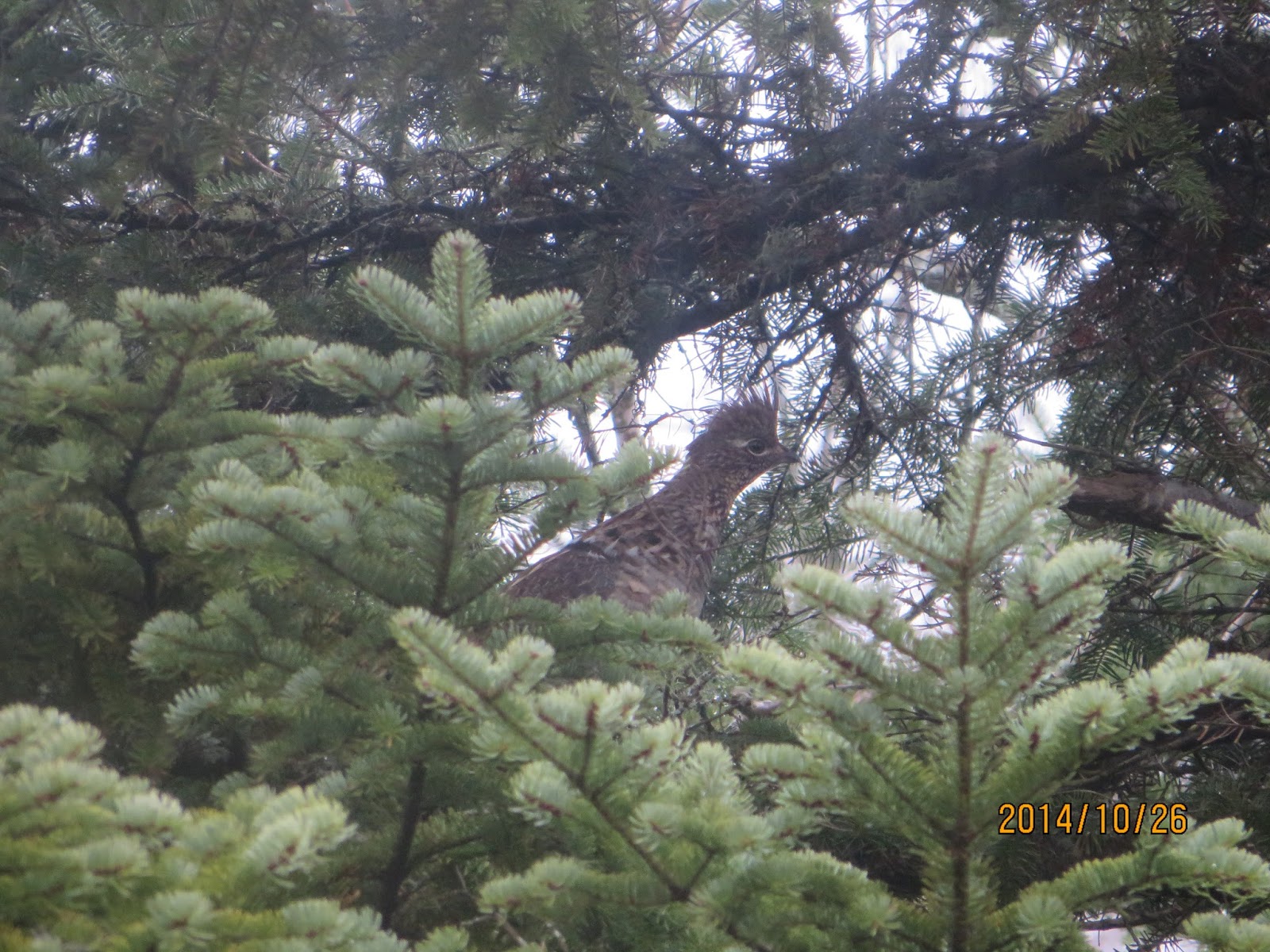
Showing posts with label Winter ruffed grouse. Show all posts

Saturday, December 28, 2019

Snow Roosting


      Christmas Day was quiet at Camp Grouse. Family was far away and friends were busy. We unwrapped presents early then ate a giant breakfast. The weather looked perfect, so we opted for a day outside with the dogs. It certainly wasn’t our first Christmas spent in the woods.
      Around Camp Grouse the snow looked a bit thin, so we drove north where the land is a little higher. Sure enough, the snow depth more than doubled to maybe eight or ten inches. We stopped beside an old logging road with fat tire tracks in it. Those tracks would make walking easier.
      One of the treats that day was finding a recently abandoned ruffed grouse snow roost.
A ruffed grouse snow angel.
      When the temperatures drop ruffed grouse seek shelter in the boughs of softwood trees or down inside soft snow. The R value of snow depends on the moisture content, but usually is around 1 per inch, about the same as wood. The R value of those rigid closed-cell foam panels is somewhere around 5 per inch. A bird hiding under a foot of snow would be sheltered by an R value of 12. Add to that the protection from the wind and you can see why grouse love to bury in the snow.
      One possible catastrophe for grouse is freezing rain or sleet that traps the bird under the snow. Hawks are unlikely to find a grouse hiding in the snow, but some predators, like coyotes or foxes, may smell their presence. Of course guessing where to dive into the snow to snatch a ruffed grouse requires a bit of luck. I have also heard of birds diving into the snow and hitting an object like a stump or rock, resulting in a broken neck. The odds of finding a dead grouse before a wild scavenger does are long.
      When someone says to me “Go take a hike”, we generally do.


Thursday, January 11, 2018

Squeaky Snow

 
Maggie
    As I write this it is late December at Camp Grouse. Among the hillside hardwoods two feet of snow covers the ground. Temperatures have been below zero for days and dipped down to thirty below a couple of nights. Cabin fever starts to set in after a while and when temperatures climb to near zero it is time to put on the snowshoes.
      Our younger German wirehair, Maggie, is game to go. She loves winter and rolls in the snow daily. Colby, our older girl, will pretend to want to go, but after I leave she’ll curl up quite content beside the wood stove to dream of summer.
      From the house, Maggie and I head down into the softwoods, snow squeaking with every step and our breath in a cloud. She bounds through the snow with enthusiasm. In the shelter of the spruce and fir trees the snow is hard, crunching beneath the snowshoes despite the dusting of fluff on the top. Maggie can easily dash about atop the snow, following the confusion of snowshoe rabbit tracks.
      Deer have passed through, punching deep imprints in the hard snow. The coyotes barely made tracks, but traveling on top with such an advantage over the deer.
      Our favorite brook trout stream is silent, capped over with ice and snow. It is hard to imagine trout fishing and I wondered where the brook trout went for the winter. Surely they are not in the same riffles as they were in July, but probably in the deep dark holes where the current is slow or nonexistent.
      We follow downstream. Maggie shows no interest on going out on the ice, which is what I had hoped. I like smart cautious dogs. They seldom get porcupined or skunked more than once.
      Snowshoes on crusty snow drown out any other sound. Mice tracks, squirrel tracks, rabbit tracks, all create a puzzle. Fat well-spaced trunks of conifers cover the plateau along the stream, making travel easy.
      We pass where the coyotes killed a deer the previous winter. Maggie sniffs about and I wonder if there could still be scent after so much time. Dogs amaze me with their noses and nothing seems impossible. She squats to urinate, to say to the coyotes “Hey, I was here”.
      Leaning alders, bent by the snow, block the path and I crouch to walk under them. A busted fir tree, broken by an early winter wind, demands a detour. Another fallen fir, this one uprooted, reaches out halfway across the stream. Eventually the stream pinches against a steep ledge to cut off our course, so we turn back and inland to follow the edge where the softwood trees of the lowlands meet the hardwoods of the hill.
      The snow is deeper, but Maggie still flies about, first up the hill then down into a thicket beneath a cluster of firs. She points, relocates, points again, and then zips off to hunt still more. 
      Grouse tracks cover the snow where she stopped. I stare up into the trees, hoping to glimpse one, but see none. I did not bring a shotgun. With the extreme weather I really don’t feel like bother them and seeing the tracks is enough for me.
      Heading uphill and back toward home, another shattered fir tree blocks the path. I trudge around it beneath three big softwoods. Ahead of me, Maggie again points for a moment before charging onward. Grouse tracks go every-which-way where she stopped. The bird never wandered far, but created a tangle of tracks beneath a cluster of young maples, all in an area the size of a large dining table.
      I search among the tree limbs, but again find only empty branches. Hopefully the bird is sitting somewhere safe with its belly full. We are close enough to the house, so, if this one is a male, we will sit on the deck and hear his drumming in the spring.
      A late day chill reminds us it is late. The low winter sun has slipped behind the hills early and the sky has dissolved from blue to the color of steel. Up the hill we find a skid road that takes us around the bottom edge of another softwood stand. Water runs beneath the snow, creating a murmur that is almost impossible to hear. In the summer mud would be everywhere, but a pristine white blankets everything. The deep snow makes breaking trail work, but Maggie still bounds about. Eventually, the road leads to the far end of the field behind our home and I can see smoke wafting up from the chimney.
      There is no place I would rather see or be.

Thursday, February 9, 2017

Winter Grouse

Our brook.
We walk often in the winter. When the snow is deep enough that the dogs bog down, the plowed logging roads become our choice on weekends. But the favorite is below Camp Grouse, a path that follows where the flat wetlands meet the craggy hill before turning back and following the brook. Most of its course is beneath softwoods or a mixed canopy, and with regular walking the path is packed enough that snowshoes aren’t necessary. Underneath the softwood trees the dogs can usually manage without sinking into the snow too.
          The path can be walked every day for a week without a new animal track crossing anywhere, then, as if in chorus, a half dozen species will have traipsed about. Snowshoe rabbits are the most common, which are hares really. Lately turkeys are probably the second in number. Then there’s a mix of coyote, beaver, bobcat, mice, otter, small birds, deer, and an occasional moose.
Grouse tracks
          The track I am always looking for is Mr. Grouse. Sometimes he is close to our house and sometimes further away. Seldom is he deep into the softwoods, but more likely along the edge where hardwoods mix in. The dogs will sniff the tracks and follow, but they almost never find him on the ground. Occasionally he bursts from a softwood tree high up overhead and the dogs get excited at the sound. I am sure that most often we pass beneath Mister or Misses Grouse and they just watch.
          The population is down this year though, so hearing a grouse isn’t as common as it should be, nor are there as many tracks as some years.
Colby among the long shadows.
When the weather is bitter and the birds are struggling, it is a shame to have them wasting energy on useless flushes to avoid no real danger. I neither encourage nor discourage the dogs. The older one is happy to stay on the packed trail and would be happy for us to move to where winter never would come. The younger dog dashes about, oblivious to the snow and cold. When a grouse does flush out of a tree I cringe a bit, hoping it doesn’t fly far or burn too many calories.
       Last year little snow fell and snow roosting would have been impossible for the grouse. Snow roosting, where the birds dive and borrow into soft snow, keeps the birds warmer on cold nights and hides them from owls and hawks. Perhaps that is part of the reason the grouse population plummeted.
      This year the snow cover is sufficient for snow roosting and, so far, there have only been a few really cold nights. Hopefully the grouse that are in the woods now will still be there to breed in the spring.
      With the lengthening days we should hear the drumming soon. 

Saturday, January 7, 2017

A Winter’s Walk

    The snow is deep and climbing over the plowed up snowbank is difficult. Then caution is required going down the slope, although slipping would only land one in a bed of thick fluffy snow. Stepping into the shelter of the softwoods a tiny stream gurgles beneath the snow, but a few steps on there is silence. The new snow has stolen all sound.
     The dogs zig and zag, following their noses and scents we can only try to imagine, snow is flying everywhere, then they disappear ahead.
    Boisterous squawks and clucks and thundering flaps of wings ahead!
    A big black turkey flaps overhead, then another. Hurrying on, the huge three toed tracks cover the snow. The dogs bound about with enthusiasm, going back then rushing ahead. Another turkey is aloft…five in all.
 
   When things quiet we proceed. Colby, the oldest German Wirehaired Retriever, stuffs her head into a fresh deer track. There are many tracks, all headed down the hill and none were there before this last snow. Both dogs show interest, but neither follow, instead vaulting ahead on the path hidden by snow. They know the way.
    An opening in the forest allows sunlight, it is almost a small field, and another slope through wrist-sized maples takes us to the valley’s bottom. More deer tracks, most wandering, with a few snowshoe hare tracks mixed in.
    Beneath tall softwoods a stream rushes, coming down through ledges above us and hidden by ice to be easily crossed. Only the muffled babbling gives away its presence.
    Next to the edge of a meadow, whose tall grasses are unseen beneath the snow, stands a fat ancient white cedar. The deer have beaten a path, coming down a particularly steep slope and passing next to the big tree. Maggie, the younger wirehair, plows through the open meadow in big bounds, the feathery snow up over her shoulders.
    On the far side we hear a grouse flush from a tree.
    Our path follows the edge where the soft boggy open ground meets the forested steep rocky slope. Above us spruce, maple, and birch cling to craggy ledges. Fractured rock shapes the hillside, creating vertical walls. A deer used our path since the last snow while one or two others crossed the spongy meadow.
    In a thicket of young fir trees we leap over a small brook. No ice has formed there yet. Only a couple of weeks ago spawning brook trout swam in the gravely shallows. Perhaps the soil of the boggy meadow warms the water to keep it from freezing. Beyond the stream the softwoods are huge and again swallow up the sound.
Branches bent with snow hang into our trail, sometimes sneaking snow down the collars of our coats. The path is hidden beneath the new white blanker and we stop to sort things out.
    A second ruffed grouse thunders from high up in a fir tree.
    The dogs sniff beneath its branches with tails wagging. There are no bird tracks in the snow. In ever widening circles they search. We walk on.
    Approaching a dogleg in the main stream we pass through alders then step out onto what is a gravely bar in the summer, but now is a plateau of snow. On the far side a small field allows the north wind to drift snow over the stream’s banks, creating wavy shapes with sharp edged shadows. A gentle wind nips at our faces so back into the shelter of the tall softwood trees we go.
    An otter created a shortcut where the brook makes a bend, leaving a lumpy trough through the snow. How many trout might the critter consume in the winter? Our path now parallels the stream. Pools that hold trout in the summer are now covered with ice and snow, but dark inky runs and riffles have so far remained fluid.
    Deer have crossed where the forest hugs the stream from both sides, avoiding the field and a near vertical slope ahead on the far side. Rabbit tracks mix with the deer tracks. Squirrel tracks look tiny. Unidentifiable little tracks look like stitching on the snow.
    A fir that leaned over the stream the past three summers has shattered from the weight of snow and now bridges the stream, its stubborn jagged stump pointing defiantly upward. Clumps of ice cling where the green branches touch the water and balls of snow sit atop, while dark water bulges around their bases.

   The path continues between the straight trunks of tall spruce and firs. Rusty barbed wire, inches inside the wood, stretches between a handful of trunks. Other fallen trees lay cross the stream, but have done so for two or three years. One day a large spring runoff will carry them away, but in the meanwhile summertime trout hide beneath.
     At another large bend, where the stream alters its course to create a gravel bar half the size of a tennis court, the otter again made a shortcut, probably preferring the shelter of the woods to an open exposer. Even though its tracks are fresh, the dogs show no interest.
    In the opening a second freshly fallen fir collects ice and snow, enough to make the water bulge on the upstream side. The spring freshet will rip the tree from the bank for sure and again change the shape of the stream. In ten years that gravel bar has quadrupled in size.
    Maggie covers all of the flat ground between the stream and the hill, hunting hard and oblivious to the snow. Colby doesn’t like the cold or the snow and stays closer. Neither dog shows any interest on walking on ice where the stream is frozen, but we keep an eye on them anyway.
    Beneath tall softwoods the path bends where the water has undercut the banks in another sharp turn. Upstream, an almost continuous riffle creates a long straight stretch. Rabbit tracks weave with no discernible pattern. In an abandoned field on the far side, alders have flourished to create what looks like excellent woodcock cover.
    Eventually we turn away from the water to cross to the slope that will take us up to our home. Deer have followed the edge of the incline, staying in the dense cover of young fir trees. Their tracks pass under unbelievably low leaning dead softwood trunk. We pick through the thick trees up to an old skidder trail then follow it up the hill.
   Ahead of us is home.


Monday, December 26, 2016

December Grouse

There is a grouse hiding in there.
    In our neck of the woods most of the grouse hunting stops when the deer hunters enter the woods the second week of November, but early in December the riflemen leave the woods to the shotgunners again. The late season can provide of the loveliest hunting of the year or the snow can be so deep the dogs cannot work. Nothing is certain.
    The grouse will be in different cover than October, with most of the fruit gone and snow possibly covering ground covers. Buds and catkins will make up most of their diet, but the birds also eat a variety of green leafy plants if the snow isn’t too deep. Hunting the edges of thick softwood stands usually is productive.
Grouse picking at catkins
    Just like early in the season, often groups are found, frequently up in the boughs of softwood trees. On sunny days they will come down to feed, foraging for whatever they can find or to just soak up the sun on a south facing slope. But when the weather is wet or cold it is easier to retain body heat in the protection of the softwood trees.
    In December it is possible to drive twenty or thirty miles on logging roads and never see another vehicle. Of course you don’t want to have truck troubles when you are fifteen or more miles in the woods by yourself. Keep that in mind and be prepared for a vehicle that might not start.
    A few years back, hunting late in the day in a stand of softwoods long since harvested by the loggers, I stumbled into a covey of grouse that flushed from high in the trees. Most flew across the logging road into a cutting that the previous fall had been waist high weeds with scattered Christmas-tree-sized spruce and firs. By December the weeds had been flattened by rain, frost, and a little snow, so it felt like an open park.
    Almost immediately my dog pointed at the base of a fir. On my approach the bird flew out the back. A minute later the scene repeated, but I went to the left and the grouse to the right. The scenario repeated a couple more times. If there had been someone with me the shooting would have been fantastic, but the grouse were successfully using the trees as shields. Finally, my dog pointed a grouse that had made the fatal mistake of landing in a raspberry patch surrounded by flattened weeds. When the bird thundered up above the brambles into the wide open spaces it was one of the few easy shots one ever gets on grouse.
Chara during a late season adventure.
    But the whole time, in the back of my mind, I kept hoping my truck wouldn’t let me down. It was fourteen miles from there back to the pavement. That weekend I drove over forty-five miles on logging roads and saw only one vehicle, which happened to be a logger.
    When the weather gets bitter many who love ruffed grouse hang up their guns and call it a season to give the birds a break until the next year. Biologists say it doesn’t make a difference in the overall grouse population, but I still can’t harass the birds when conditions are tough. The struggle for calories to maintain body temperature is harsh and one unnecessary flush could be the tipping point in the delicate balance. I prefer to think that a grouse left alive will have a big brood in the spring.
    This year the grouse numbers were down. When the deer hunters left the woods I took the dogs for a few late season hunts, but I’m not sure I would have killed a grouse. The dogs loved wearing their bells again and hunted hard. I carried my shotgun, but never raised it to my shoulder. The few birds we found all flushed from high in softwood trees, with most leaving unseen, and I wished every one of them well.
    The shotgun went into the safe to wait out spring and clay targets.
    Let us hope the grouse survive and the spring weather is kind to the young broods.

Tracks.