Showing posts with label upland hunting. Show all posts

Friday, September 18, 2020

The Late Sixties


 My family had property on Cape Cod, only about a mile from the south shore and on the coast of an inland bay. That area was one of the last to develop on Cape Cod.
    The Cape was pretty wild back then. We didn’t have electricity until the seventies and at night there were no lights from any neighbors, except for one streetlight across the bay, which was well over a half mile away. Often the whippoorwills sang us to sleep.
    The woods was thick with poison ivy and bull briars. The story I heard was the hurricane of thirty-eight killed all the trees. Maybe that was true. There were pictures of tall dead pines towering over the scrub that pushed up over the sandy soil. In the sixties very few trees were over twenty feet tall. At night it was very quiet.
    As a young guy with a shotgun it was paradise. Rabbits were abundant, but, even with a determined beagle, you rarely saw them…the cover was just too thick. Grouse and bobwhite quail hid in that thorny jungle. Both were almost impossible to shoot when they flew. At times hundreds of geese would land out on the bay. Thousands of black ducks hid in the marshes every fall. I remember seeing the bay, which measured about a half mile by half mile, covered with blue bills from one shore to the other. What a time it was.
    The first grouse shot that I can clearly remember was shot by my brother and me simultaneously. Neither of us realized that the other had even fired their gun. Cleaning the bird later we found both number six and seven and a half shot in the bird. Obviously, it was shot by two different hunters.
    My first hunting dog was a beagle named Thorin, named after the character in the Hobbit book. That dog would disappear into the underbrush and chase rabbits until late when the sun sank low in the sky. His eternal baying was the only way one could keep track of his location. At dusk he would emerge, limping home and looking for supper, usually too sore to even pat.
    I would pick thorns out of Thorin’s hide and let him sleep. There’s something about the hide on a beagle that is pleasant to touch. In the morning he would be ready to go again. What fun we had.
    By the eighties the upland hunting was pretty much done. Houses lined the shores of our bay and the woods had been divvied up into house lots. An occasional ruffed grouse could be found, but did you really want to shoot something so rare? The quail and whippoorwills had disappeared with the maturing of the forest. As the underbrush disappeared so did the rabbits.  
    Today you can still find grouse down there, but you really have to look. The bobwhite quail are nearly impossible to find. The eastern cottontail rabbits are on the endangered species list. At night the lights of houses ring the bay. Geese still pass through, but the clouds of ducks are gone.
    Do you ever wonder what your favorite coverts are going to look like in fifty or sixty years? Take a good look at what you have today so you can remember it.


Sunday, January 26, 2020

Looking for the MotherLode…


The end of October had arrived and the gang had left. It was prospecting time, which means searching for new grouse cover. It’s done every year, usually after all the friends have left. There’s no use dragging them around the wilds to places that may or may not hold birds. Sometimes the terrain gets mighty rough in our rugged neck of the woods and exploring what might be birdless cover isn’t always appreciated. Good grouse cover can go from prime to thin-pickens in about ten years, so it is always necessary to be prospecting for new coverts.
      The clear cut showed up on Google Earth and was back in a section of country that’s been full of grouse the last few years. The cut covered probably two hundred acres, but hid behind a stand of thick softwood trees, so it wasn’t readily visible from the logging road. All that, and fourteen miles from the nearest asphalt in some mighty rugged terrain made it seem promising and maybe even un-hunted.
      It would be one of the last hunts of the year, so I let all three dogs out for the hunt. Pandemonium can be fun. From where we parked a skid trail turned into snowmobile road, wide as a thruway, that seemed to run upward forever. It passed softwoods to the left while a stream gurgled in a gully filled with hardwoods to the right. When the softwoods gave way the cutting looked enormous. We trekked to the top and an old road continued into the shade of mature hardwoods.  The view back across the forested valley was stunning.
The nearest paved road is over those hills.
      The cutting probably was two years old with relatively easy walking between the poplar and maple sprouts. The loggers had taken away all of the tree tops, leaving the ground relatively clean. Wet spots were covered with grass and moose tracks. Sprouts crowned the hardwood stumps, but most weren’t shoulder height. Wild raspberries grew everywhere. It really wasn’t good grouse cover yet.
      The dogs and I hunted along the top of the cutting and then down the west side.  It didn’t look too encouraging, with no softwoods to offer shelter for the birds, but ahead and about halfway down the slope I could see softwoods left behind by the logging operation.
      Approaching, I noticed a small knoll covered with softwoods.
      Now I love knolls, because grouse love knolls. What better place to sit and collect morning sunshine and survey the surroundings. No matter which way danger approaches, the grouse has a downhill escape route that leaves them out of sight in the blink of an eye.
 
Chara on a bird.
    About then I wished my friends hadn’t all left for those flat lands to the south. Approaching the hump the dogs’ bells eagerly rang. And then I could hear the birds accelerating off the far side. There were at least four. If only someone could have been standing on the far side, it would have been like one of those European driven hunts.
      On the other side of that little hill the cutting opened up again with scattered softwood clumps further down the slope. Stopping for a moment, I tried to guess where I would go if I were a grouse and picked an open alley that led downhill into a softwood swamp.
      At the edge of the spruce and fir thicket my oldest German wirehair, Chara, locked up on point, almost completely hidden by young waist-high fir trees.
      A bird busted out wild.  Missed. Opening the gun to reload, a second bird rocketed after the first.
      Encouraging the dogs on, Colby, my youngest wirehair, pointed a grouse sitting about twelve feet off the ground in a yellow birch.  It flew on my approach, sailing away ahead of a swarm of shot…those birds coming out of trees are devilishly hard to hit.
      The woods got thicker, with blown down fir trees and nearly impenetrable clusters of young ones. Pushing through, it was impossible to see my feet. All three dogs became birdy, pressing under the tangles that I was forced to climb over.  Each dog wanted to find the birds first.
Colby coming out of the
thicket with the bird
Georgia pointed.
      I couldn’t locate Georgia, the young German shorthair, but then spotted her frozen about eight feet in front of Colby, who was honoring. The thick green fir boughs almost buried both of them. Before I could get within twenty yards of the dogs the grouse rumbled upward and a reflex made my gun fire. It was a prayer shot, but I saw a bird’s wing flutter…maybe. With the softwoods so thick a dead bird might get caught up in a branch and never hit the grouse. The dogs had disappeared.
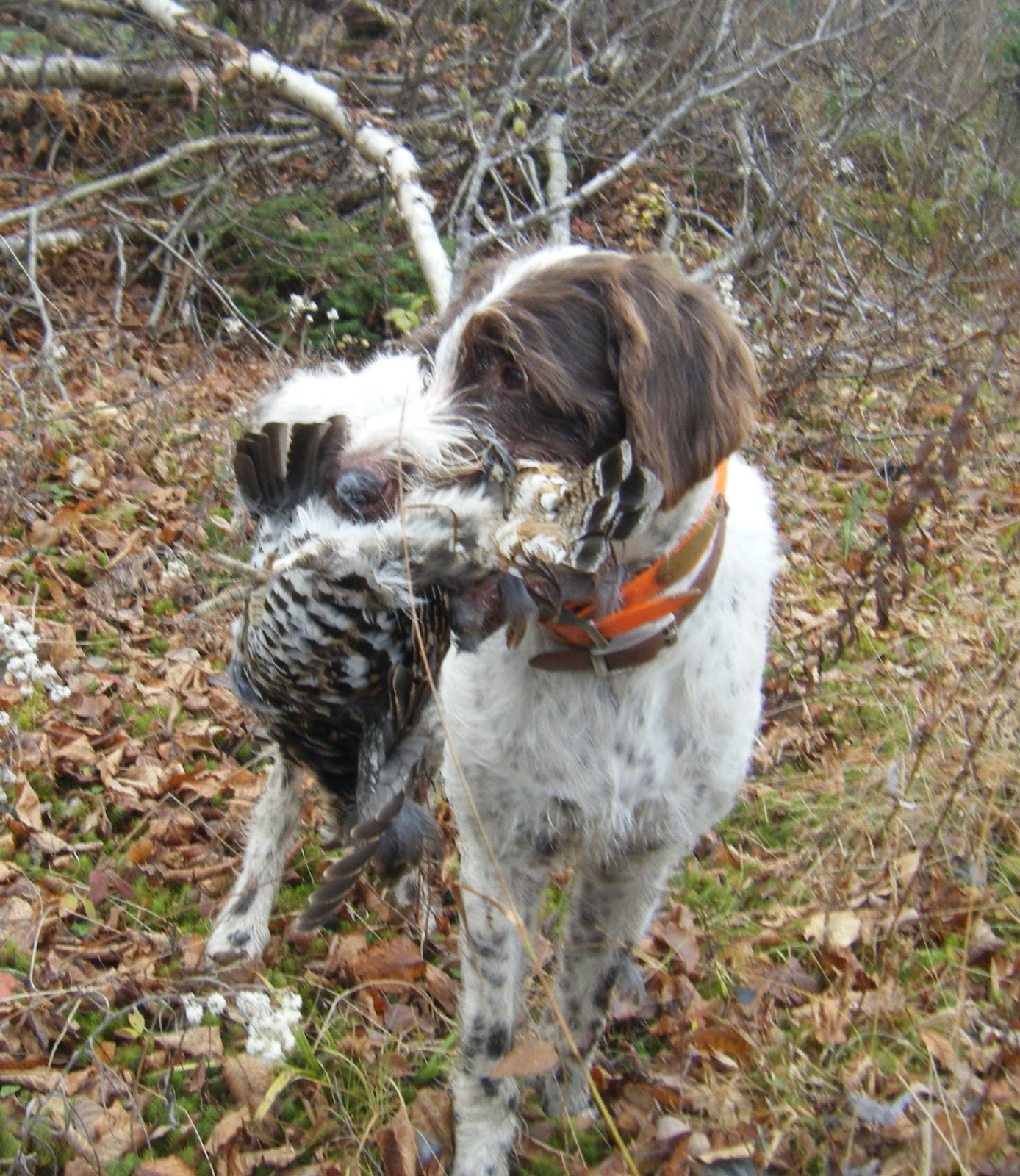
      And then Colby came pushing through the brush with the bird in her mouth. What a great sight.
Georgia checking out the
grouse she pointed.
      We hunted down the hill, moving three more grouse, but killing none. Coming out of the swamp into the more open clearcut Chara pointed and a woodcock flew up on my approach. Twisting among the branches of two fir trees, it quickly escaped.
      We went back the next year and I brought my friends. I wish all my prospecting trips turned out that successful.


The gang, Georgia, Colby, and Chara, taking a break
beside a logging road.


Saturday, January 18, 2020

A January Thaw


January is a bit confused. The temperatures have been in the forties and low fifties the last few days and dipped to the upper thirties at night. That certainly isn’t the usual January weather, but it has happened before.
     The snow in the woods has settled and firmed up to the point where grouse won’t leave tracks. Down under the softwood trees, in the flat along the stream, we still see deer tracks and squirrel tracks. Usually there are snowshoe hare tracks, but apparently their big feet don’t leave impressions in the dense snow. Last week, when the snow wasn’t so solid, fisher tracks wound along the edge of the flat where the land starts to climb.
     Rain fell all last night and much of yesterday. During a break in the precipitation our young dog and I walked down to look at the stream, but it was out of its banks and the entire forest floor was flooded, making it impossible to walk anywhere near the stream bed.
     I am certain the grouse were safely up in the trees watching the water flow beneath them. The day before a grouse flushed from the edge of the softwoods when we walked down the hill. Our youngest wirehair, Maggie, always seems to find one somewhere, so they are around.
These green ferns were buried in the snow before the
January thaw. In winter grouse seem to love green anything.
     This afternoon the dogs and I walked up the hill and made a circle around the east end of our property where the forest crowds the driveway. Under a canopy of softwoods, Maggie locked up on point, much to my surprise. The thick boughs of the spruce and fir trees had thinned the snow enough so green ferns covered the nearly bare ground. When I took a step ahead a grouse exploded from a blown down fir tree, heading southward to cross our driveway. Great fun.
     Tomorrow will be colder and the long range forecast is for bitter weather again. Let’s hope deep roosting snow comes with the cold weather.
     New England weather is never dull.


Sunday, October 27, 2019

Ice On The Puddles

Morning fog usually means
nice weather.

     There is ice on the puddles now, at least first thing in the morning. At sunrise fog fills the valleys and the moisture freezes on the leafless branches of the trees. Golden or brown weeds and dead grasses have started to tilt or fall down. The fluffy seeds on the goldenrod look like cotton.
     Grouse hunters wait patiently for this time of the year. Temperatures are cool enough the dogs don’t overheat. Woodcock are still around to offer bonus birds. And, best of all, the leaves are pretty much gone from the trees. Green leaves may still cling to an occasional apple tree or the crown of a poplar may glow golden, but it is much easier to see in the woods.
High bush cranberries.
Young poplars.
     Gaudy red fruit hangs from both high bush cranberry and mountain ash this year. Apple tree branches weep under the load of their fruit. Now that the frost has softened the apples the wildlife love them. Find food and maybe you’ll find grouse, but this year there is so much to choose from the grouse could be almost anywhere.
     So we try to get out often. The dogs have firmed up their muscles and shed a pound or two. The hunters have too.


Maggie with a hard earned grouse.


Wednesday, October 9, 2019

Birds Be About


      It’s that marvelous time of the year. Grouse season opened a little over a week ago and we’ve been out almost every day. The dogs pointed like champs and a few birds have fallen to the gun. We are working on consistency.
      Apple trees, hawthorn, high bush cranberries, and mountain ash are all so loaded with fruit that their branches sag. Choke cherries are almost black by now. Birches and maples are loaded with seeds. Every creature of the forest is gorging on the smorgasbord. Any hunter trying to use bait to lure in game is suffering an uphill battle.
      We have found the ruffed grouse up high in the hills and down at the edges of the farmland in the valleys. Woodcock are wherever the ground is damp and not crowded with weeds. Our daily averages are slightly above the long term normal.
      Our old girl Colby doesn’t cover a lot of ground, but she never bumps a bird. Maggie, at three and a half years of age, still lets her enthusiasm get ahead of her wisdom and occasionally bumps a bird, but she finds a half dozen birds to her older sibling’s one. Watching them develop is at least half of the fun. 
     It is the most wonderful time of the year.


Sunday, September 22, 2019

Late September

Fall colors are happening.


      We wait all year for October. Time slows almost to a standstill as the end of September grows closer. On cool days we run the dogs, hoping to get them and ourselves into shape. The woods is still a jungle of leaves. Birds are bumped, some are pointed, and most disappear before anyone could ever shoot them.
      This week was a good one. Grouse were found on a couple of morning walks and the leaves are starting to put on quite a colorful display. As the week ended the weather turned a bit warm, but we managed to get out while it was still cool. 
      The dog's bells and orange collars were dug out a couple of weeks ago. The waxed cotton clothes may get a re-wax, depending on their wear. Hunting knives are located and touched up on a stone. Boots will be treated with waterproofing. Clean shotguns are cleaned again and lovingly oiled. Preparation can be half the fun.
      Hunting journals jog memories of long forgotten coverts. Topographical maps and aerial images are studied. Friends call who haven’t called in a year. Nobody is more popular in October than someone who owns a home in grouse country.
      It is only eight days until the season opens.
Young of the year sitting in a tree.


Wednesday, November 28, 2018

Late Fall


     It has been a great bird season for you, with two limits of ruffed grouse and plenty of excellent dog work. The real world called you home the end of the second week of October, but now you are back in the woods and the leaves are long gone. Things couldn’t be better.
     You hunt this same piece of cover that you did a little over two weeks ago when you found a dozen grouse. Today, with an inch of new snow on the ground and the weeds bent over, the forest seems to be shades of gray. Where are the grouse? What happened? Where did they all go?
     The ruffed grouse have moved. It happens every year. The edges of that clearcut, up high on the hill, where you found so many birds early in October now feel empty. For three hours you have walked and not found a single ruffed grouse…not even a track in the newly fallen snow. Your dog, Banjo, is working her butt off and is as enthusiastic as when you left your truck, but you don’t feel that way.
     You encounter a stream and follow it downhill to where it slips through a culvert beneath a logging road. Still, not a single bird. Crossing the road, you continue down the hill to where the hardwood stand peters out to mix with softwood trees. Banjo’s tail is a blur until she locks up on point.
     As you approach, a grouse steps off a small knoll and disappears down the hill deep into a darkness of the softwood trees, almost like a sky diver stepping out of an airplane. The precipitous drop-off discourages any attempt to follow, but seeing a single grouse has lifted your spirits. You turn to the left to follow the edge where the softwoods and hardwoods mingle, heading back towards your truck.
     Green ferns still poke up through the new snow.  In places a ground cover with roundish palm-sized green leaves shows through the white. A bird flushes from a little over head-high from a fir tree, startling both you and Banjo.
     And it brings a smile to your face.
     In a tight little valley someone has cut a couple of acres of hardwoods trees that abut a stand of hemlock. Alders cluster in a wet area. Poplar and maple sprouts are everywhere. Raspberry vines tug at your pants.
     Banjo goes on point, but before you can walk in front of her a grouse rockets up from the ground and another blasts out of a tree. With a prayer you swing on the one coming out of the tree and see it fold, not even aware that you pulled the trigger.
     Later, back at the truck, you will clean that bird and find its crop filled with buds, catkins from alders, and a few flecks of green foliage.
     The grouse had moved. With the cold weather coming they sought out the shelter of the softwood trees. The seeds and berries that they ate earlier in the fall, up higher on the hill, are gone. Catkins and buds will be their winter diet. When green ground-covers are available they will eat those too.
     It happens every year. As the colder weather settles in, ruffed grouse seek the shelter of the softwood trees. Look along the edge of a softwood swamp. The alders and birches supply plenty to eat with safety nearby. Pockets of dense softwoods around recent cuttings can be good too.
     The birds are there, you just have to work for them. Isn’t that what grouse hunting is all about.


Thursday, June 14, 2018

What’s It to You ?

Speed on the water.

     I once lived amongst the world of diehard sailors. Some raced two or more times a week and had to be the first to everywhere. Every piece of gear on their boats was of cutting edge technology. Other sailors just wanted to be out on the water, headed for a quiet cove to spend the day. Some had to cross an entire ocean to be happy. A few never went anywhere, but instead used their boat mostly for entertaining or just a platform from which to read a book. Many of my friends worked on boats, lived aboard boats, and went sailing on their days off. Every one of those sailors enjoyed their boat and who’s to say who enjoyed theirs the most.
Which fly today?
     Fly fishing is sometimes like that. One angler has to match whatever insect is hatching, while another is quite content to throw the same fly that he threw the day before and the day before that. Some fish as if their life depended on it, while another may find a sunny spot on the shore to stretch out and take a nap. Who’s having the most fun?
     Bird hunting can be the same way. Some hunt until their legs are ready to fall off, with anything less than a limit an impossible thought. Others may mosey along, content to watch the dogs work while they chat with a buddy. Many love their old shotguns and bird hunting is an excuse to get them out. Bird dogs are the passion of a huge number of bird hunters, and many wouldn’t bother to walk into the woods without one. To some, it is an excuse to be out in the woods watching song birds, looking for deer tracks, and possibly shooting a bird along the way. Who is having the most fun?
     When I was younger killing birds seemed very important, much more so than it does now. My dog was steady to wing and shot and, by the time a day was over, my legs would have felt better if they had fallen off. I have to admit, I always slept soundly after a day in the woods.
Georgia pinning a ruffed grouse.
     I sleep just as well now, but during a day afield I notice a lot more. Around here there are old stone foundations and long lost apple trees. A beaver pond might harbor a wood duck or a half dozen black ducks. A woodcock or two might hide among the alders in valley around the other side of the hill…or is it the hill beyond that? Sometimes I just follow an old logging road to see where it goes.
     Every day is an adventure. My dogs no longer are steady to wing and shot. Hunting alone that was difficult to enforce and caused a lot of frustration, both for me and my dogs. They still hunt hard and point with intensity, but more like cowboys than mechanical soldiers. If dog safety is an issue on low flying shots, I just let the bird go. One bird in the game bag feels great, and after that anything more is a bonus.
     Don’t get me wrong, I love to watch dogs preform flawlessly and to see birds drop in front of gunners that never miss. You have to admire the determination and discipline that brings such results. If it makes them happy, and I certainly hope it does, it makes me happy.   
     Instead, my dogs are my buddies, under foot both in my shop and in our home. I still try to rule the roost and make sure their manners are impeccable, and we do get out in the woods often, probably much more than most. Experience and birds in front of the dog’s nose are the best teachers, so we try to get out a lot..
     But I’m willing to cut them some slack, as long as they are willing to return the favor.


Wednesday, January 3, 2018

Worm Soup

Alders
      The rain had finally stopped. It was time to get the dogs out hunting again. With the youngster in the house, Maggie, that meant looking for woodcock, because no finer bird was there ever for training a young pointing dog.
      The woods was soaked after three or four inches of rain in only a matter of hours. Winds had approached hurricane force and the power was out back at the house. Hundreds of trees were down everywhere. Logging roads would be impassible, unless one hacked their way in with a chainsaw. I opted for easier going and picked a covert next to a state road.
      Soft wet ground, like runny chocolate pudding, oozed down the hillsides. We pushed through raspberries and then blackberries into a stand of young alders. Maggie and Colby were in hyper mode, hunting hard, oblivious to the mud. Down the slope we sloshed. Then, where water puddled among alders, a bumped woodcock flew back over my head.
A rock pile left by a farmer.
      Clumps of young firs, growing on a series of hummocks the size of overturned bushel baskets, divided the alders from more poplars. We skirted an enormous pile of moss-covered rocks, left by a long gone farmer, and another thicket of blackberries. More fencepost-size poplars stood above bent and brown ferns, then into another cluster of alders we waded. Where were the woodcock?
      Far ahead, Maggie’s bell screamed silence. Colby’s still rattled off to my right. Then Colby’s fell silent too. Silence. Two dogs were pointing, what to do? How long would the young dog wait? I quickly stepped in front of closer Colby, knowing that if a bird flushed a gunshot would send Maggie into overdrive.
      No bird, I breathed relief, then hurried toward Maggie, while saying to Colby, “There’s no bird Colby. Where is Maggie? Let’s go find Maggie. This way girl, come on, this way.”
      Colby zigzagged through where she thought the bird was, but, finding nothing, she galloped ahead, disappearing into the alders. Ducking under and stepping over limbs and leaning trunks, I first saw the unmoving white of Colby’s coat and then Maggie’s brown silhouette, like a statue a dozen feet ahead of her. My heart pounded.
Soggy ground. How many dogs in the picture?
      Trying to approach through the tangle was frustratingly slow. And I needed to be able to stand to shoot, but the world was a jumble of limbs and trunks. As I stepped over a roadblock of tilting alders, the bird tweetered toward the sky. A shot is pointless, but tried anyway. The bird disappeared into the swamp.
      The dogs went into overdrive, fueled by bird scent and gunfire. We worked downhill to where thick grasses grew between the alders. Water was everywhere and the ground felt like stepping on a soggy pillows. Turning to the right, we followed where the saturated bare ground met the soaked grasses.
      In a spot wetter than most, puddles and pools dictated detours. Maggie pointed thirty yards ahead. As I tried to find a route towards her, Colby pointed to my right. White splashes covered the ground. A step toward Colby sent another woodcock aloft, but a shot was impossible. I hurried toward Maggie and a second one launched, offering an easy going away shot.
      After that the dogs were wound tight, with bird scent is in their nostrils and the taste in their mouths. Hunting hard and fast, they covered a lot of country, while I struggled to keep up. The scenario repeated three more times in the swampiest of places. Only one more bird fell to the gun.
      What were these birds eating? Drowned earth worms? Marinated in rainwater? How did the woodcock stay dry? Ducks would have swum happily between the trees.
     After we turned back toward the truck, I attempt to steer the dogs toward an old apple tree where ruffed grouse like to loiter. To my left, Maggie was up the hill further than I wanted and out of sight. Then her bell fell silent. I coaxed Colby in that direction, hoping she would find her for me.
      But Colby went on point where a small stream created an expansive quagmire in a flat spot. That woodcock flushed well ahead of me and disappeared into a cluster of firs. Colby dashed off toward the apple tree. Mumbling to myself, I headed toward Maggie and called Colby back.
      The young dog’s bell jangled again, then a woodcock weaved through the trees toward me, passed overhead, and disappeared down the hill. Impatient Maggie charged along in hot pursuit.
Wild apples and an abandoned field.
      The three of us followed the bird’s path into intertwined alders. Maggie’s bell went silent, then Colby’s too. I followed to the edge of a gully, where I could barely see both dogs locked on point not forty feet ahead of me. Stepping, twisting, crawling, and cursing, I pushed in. The woodcock tweetered upward and then down the hill, dropping like a stone beside a lone fir tree.
      We followed. The dogs hunted hard, tearing up the turf with water splashing. The bird seemed to have disappeared, but then took off next to my right foot. I never lifted my gun and neither of the dogs noticed it go.
      Hunting again toward the truck, both Maggie and Colby each found another woodcock where another tiny trickle wound down the hill, but in the tangled jungle both flew off without a shot being fired.
      Later that day we hunted across the street among ancient apple trees that the grouse love. We found no grouse, but, about to turn around and head home, I coaxed the dogs into a tiny patch of alders next to a small field. Colby instantly snapped into a point, then Maggie too. I marched into the alders and a woodcock twisted skyward through the branches. When it reached the treetops I fired.
Colby looking good.
      Colby made the retrieve and the dogs tussled harmlessly for a moment over ownership. 
      With wet feet and very happy dogs it was time to go home.


Thursday, December 7, 2017

Upside Down

Can  you see Colby pointing?
      Regenerating clearcuts make for great grouse hunting. Certain things make some better than others. I like to see young poplars coming up. Maples and birches are good too, but if there are young choke cherries I usually pass it by. Softwood trees nearby are important for shelter too, but it doesn’t take many. Grouse will walk a long way into a cut, from the shelter of softwood trees, so be sure to hunt quite a ways into the cut.
      Some clearcuts are almost impossible to walk through from the slash left behind. Others are easier if branches and tree tops were hauled away with the wood. In our area almost none of the ground is flat and the logging roads tend to be in the valleys. The best hunting if often at the tops of the cuts, because the birds see fewer hunters and frequently there are stands of softwood trees at the higher elevations. So you had better be in shape because climbing those clearcuts can mean hard walking.
      When you find a productive cutting and hunt it over the years, the trees get bigger and you probably don’t notice the changes. But one day you will realize the place isn’t what it used to be. It is because the forest became too mature and the nesting areas and food sources are gone. Grouse and woodcock are birds of the early successional forests.
There is even an old stone
foundation nearby.
      So besides hunting grouse, you continually have to hunt for new cover. If you don’t you’ll soon be finding fewer birds.
      This past fall we stumbled upon a new favorite. A logging road will take you up above the clearcut and then it is only a hundred yard walk down a gentle slope to reach it. Better still, the loggers left behind a few ancient wild apple trees that had been hidden. There is an assortment of weeds, water is nearby, and stands of softwoods break up the landscape. Clusters of young alders, the diameter of shovel handle, stand like tall skinny commuters waiting for the bus. The place is going to be a good one for several years.
     No, I won’t tell you where it is.
Maggie is pointing a woodcock.


Tuesday, September 19, 2017

Woodcock


     There is some encouraging news about the magical woodcock. In our area, their numbers have been steady the last few years because of local timber harvesting, which creates abundant early successional forests. Young woodlands are important to both woodcock and ruffed grouse. Nationally, the news is also encouraging too.


Thursday, October 27, 2016

A Tough Year


Taking a break on a hot day.
    This year has been warmer than normal and extremely dry, and where are the grouse?  
    So far the bird season has been frustrating. Early on a few grouse were found around apple trees, perhaps for the moisture in the fruit, but many of the usual coverts are empty or nearly so. Our daily average has been the lowest in years.
    A great number of the little streams that usually wind down the hillsides dried up. In the past woodcock could often be found in the moist ground along them. Alder flats that are usually wet and muddy became easy walking. In spite of the lack of rain the apple trees had a bumper crop of fruit, and blueberries, raspberries, highbush cranberries did the same. Did the abundant fruit cause the birds to scatter?
    The spring weather wasn’t unusually wet or cold, so I expected good brood numbers. Wet cold weather right after hatching can wipe out much of a year’s young grouse. The entire year has been unusually dry, and since the spring particularly so.
The usual wet lowlands were just low.
    But the weather has turned now and the migrating woodcock have showed up. The grouse are still sketchy and hard to find, yet we keep trying. Almost all of the leaves have dropped and it is a great time to be in the woods. When a bird goes up at least we can see it.
   We’ll keep trying and perhaps figure out these grouse yet.


Wednesday, September 21, 2016

The Old Guy Next Door

    The old man next door always has a bunch of dogs, sometimes three, sometimes more. I’m not sure if they all are his or if he’s just taking care of them for somebody. Somebody once told me he trained dogs for people, but I don’t know nothing about that.
    When I stop over there he’s always laughing. Don’t know what that is about. One time I even pointed out the flat tire on the back of his truck and he said, “Well if that don’t beat all,” then chuckled a bit. If it were me I would have been pissed. He just went about fixing the darn thing while his dogs got in the way.
    Behind his house he grows a big garden, more than two people can eat. His missus is the one that takes care of that. Most of the day he works in his shop, making things for people that pay him enough so he can take most of Octobers off to hunt birds. His missus is a pretty woman and I like to stop over there to chat with here whenever I can. 
    A few weeks ago the old man invited me over to shoot skeet with him. It wasn’t anything formal, like down at the club, but shooting skeet right behind his house. His dogs go crazy with the shooting, thinking that dead birds must be falling I guess. He laughs and keeps them out of the way when we launch the targets, but then they go dashing off into the weeds looking for dead things. I missed more than I broke, but he didn’t miss any.
    Twice his dogs brought back intact clay pigeons that we’d obviously cleanly missed. It was sort of embarrassing in a way, but the old man just laughed and took the targets from the dogs, then flung them out to shoot at again. Recycling he called it.
    Deer hunting is my favorite kind of hunting, but the old guy mostly hunts birds. Oh, he does hunt deer and other stuff, but every day in bird season I see he is out. Last year he invited me to go with him and it was fun to watch his dogs. It’s like they live to hunt birds, but then maybe the old man does too. You should have seen the smile on his face.
    Three times the dogs pointed, like quivering statues, and I got to walk in and flush the grouse, but I never hit a one. A woodcock flying straight away dropped when I shot, but that was an easy one. The grouse were impossible.
    This year he says we’re going to go again. I can’t wait.


Sunday, August 21, 2016

Chara

       
A special pup.
 
June 3, 2001 - August 12, 2016

     Sometimes we are really lucky and in 2001 I certainly was. Stumbling around looking for a German wirehaired pointer, I came upon a breeder in New York who introduced me to Weidenhugel Chardonnay, a predominately white German wirehaired pointer pup. It was love at first sight.
          By then more than a dozen years had passed since a bird dog had been part of my life. Chara was smart, learned quickly, loved to hunt, and became more than a dog, much like a best friend. When I worked in my shop she hung around, always ready for a two or five minute lesson. Heal, stay, whoa all came easily to her. Pigeons and quail became part of my life, for without birds you will never have a bird dog.
          The first hunt, at five months of age, was in a state run wildlife management
Learning together.
area. She pointed a pair of quail and brought back the one that fell to the shot. I never felt prouder. And throughout her entire life, her hunting enthusiasm never waned.
          I could go to the post office in our busy town and ask her to sit outside by the door and know she would be there when I came back out. Walking unleashed, she would heal through the sidewalks as people passing patted her head. I beamed.
          Exiting the post office one day a car’s tires screeched. A scared young golden retriever dashed across the street not twenty feet away, narrowly dodging the skidding vehicle. Good Samaritans tried to catch the dog, but it was too scared to trust anyone and dashed hither and yon, eyes big as golf balls. I walked to my truck and let out Chara. She trotted over to the frightened dog and the two sniffed noses. Slipping my finger into the collar of the golden retriever, then I walked the dog back to its owner. Never did I feel prouder of Chara.
   
As a young dog.
       On our first trip to grouse country she never actually pointed any of the skittish grouse, but she performed perfectly on woodcock. It was the beginning of a partnership that lasted her life time. We hunted old coverts that I had hunted as a younger man with an overly eager Brittany spaniel. Chara’s performance made that Brittany look like a fool. Together we stomped all over the north woods.
          Our first duck hunt together confused poor Chara. Why weren’t we walking and looking for birds? After all, we had a gun with us? Forcing her to sit, we sat in the weeds behind a few decays that I had carved years earlier. If it wasn’t for my hand on her neck and finger inside her collar, she would have dashed off looking for upland birds. Not long after legal shooting time a pair of mallards fell out of the sky and I stood to shoot, causing one to tumble into the water.
          About to give the retrieve command, she was already in the water and halfway out to the duck. Duck hunting was a piece of cake after that. One cold January she even retrieved a golden eye.= that fell a hundred yards from our duck boat.
          I learned to trust her nose and never doubt when she worked bird scent. Sometimes it wasn’t pretty in the classic sense, but with the nose to the ground she always found the bird. Grouse have always walked and now woodcock seem to also, but with Chara it didn’t matter, she would always find them. Point, think, wait, re-point, think, move, re-locate…it would continue, and I could always tell when the bird was pinned.
            The memories go on…the day where we must have found a hundred woodcock,
Hard on a point.
or the woodcock that fell into the river, or the crippled Canada goose that paddled out over a hundred yards from shore. Or the grouse pointed on opening day one year while her fourteen month old sibling honored, only to have the each retrieve one wing of the bird while the breast stayed where it fallen. Or the time she pointed straight up at the bird in a softwood tree? Or the day we hunted all day from the house and moved so many birds, but none really offered a shot. When I broke open my gun back at the house I had forgotten to load it. We laughed, at least I think she did too. Those things will stay with me.
          So many times, when her bell went silent and I knew she was on a point yet I couldn’t find her, I would call her name. It’s a mystery how she figured it out, or even how she did it, but Chara would move just enough that her bell would ding once, letting me know where she was without frightening the bird.
          So many other dogs passed through Camp Grouse, but Chara was always the Grande Dame. In the alder thickets or grouse coverts, she never seemed to notice the other dog’s presence. Dogs hunting with her learned a lot, of that I am sure, and I wish our young pup had had a season or two with her.
          But that wasn’t to be and last week Chara left us. It was her time, with fifteen hunting seasons behind her. It was more than I could ask and a life that most dogs would dream of, never tethered and in the woods almost every day.
In her last years she loved the cool stream.
         The last few bird seasons were easy hunts, but some that I will remember forever. Hunting over an older dog is very civilized, with a slower pace and avoiding the nastier thickets. She stayed determined and hunted hard until the end. We hunted the cream coverts the last couple of years, flat with few thorny thickets.
         Now she is buried beside the apple tree behind the house and I hope the grouse come out to visit her. I am sure they can share stories and have a few laughs. Come spring time she certainly will be able to hear them drumming.
          Chara, I will never forget you.
As I will always remember her.