If
you read this blog often you know early neutering is a subject I follow. Here
is a link to more information. The author has a great point. What is the hurry?
Monday, June 22, 2020
Thursday, June 11, 2020
Plan B
The
day took forever to arrive. For over a month hours had been spent studying
topographical maps and aerial photos. On weekends, miles were trekked looking
for the perfect cover. Finally, the day arrived.
Pulling
into the old road at first light the sight of three pickup trucks and a half
dozen men stopped me in my tracks. Rabbit hunters and beagles. Not wanting to
crowd them nor listen to their commotion, I backed out onto the public road.
I
really didn’t have a plan B. It was all new country to me. Heading back up over
a hill, I spied an old tote road marked by an iron post.
| The woods went on forever. |
That
old tote road led up the hill, nothing more than two worn indentations in the
grass beneath the trees. A stream off to the east murmured. It looked like long
abandoned pasture land and against an ancient rock maple leaned a heavy wood
door with thick iron hinges. Not a trace of a building could be found anywhere.
Softwoods mixed with the hardwoods. My girl Chara didn’t care if this was plan
A or B or C, she charged about and her bell rang with enthusiasm.
A
long abandoned field created an opening in the trees. Chara got birdy as hell,
her tail ablur. A grouse exploded from up high in a yellow birch. That bird
wasn’t going to touch ground again for a long ways off, probably on the other
side of the little stream.
I
coaxed Chara on up the hill. Old scraggly maples gave way to younger maples. It
certainly didn’t look like grouse country, but off to the east I could see
softwood trees. Following an edge is better than following nothing. I walked to
where the hardwoods met the wall of softwood trees. Chara dashed off to the west
and then back to the east, convinced the birds were somewhere. Another grouse
thundered away, this time from high on up in a fir tree.
The
softwoods petered out, but far ahead through the gray trunks of the sugar bush I
could see another cluster. Up the hill to the left stood a small sugar house
that probably hadn’t seen people since the previous March or April. Hundreds of
sugar maples covered the hillsides. I trudged on.
![]() |
| Locked up. |
A
small knoll broke up the gradual grade. Lanky spruce and fir stood over it,
with their knee-high young blanketing the ground beneath them. Chara charged up the
slope and stopped like a statue.
On
my approach a grouse exploded out the back. An easy shot and the bird tumbled.
Another launched to the north and escaped. In a blur several more exited, with
one coming directly at me. Reflexes made me duck as it flew a few feet over my
head. Attempting to collect my composure, I swung on the bird, but it sailed safely
away.
Sometimes
Plan B provides memories that last forever.
| Sometimes they are laughing at us. |
Wednesday, May 27, 2020
Ruffed Grouse or Partridge?
It
is a ruffed grouse, Bonasa umbellus, but up in the neck of the woods where we
now live the old timers refer to them as partridge. So is it ruffed grouse or
partridge? It depends on who you are talking to.
A
couple of years ago I called up a friend who was laid up during bird season. I
asked him if he wanted a ruffed grouse. He said, “A what?” I said ruffed
grouse, and he said again, “A what?” I thought there must be a lousy phone
connection. I said, “I just shot a ruffed grouse and I’ll bring it over for
you. It’s cleaned and everything.” Again he said, “A what?” Then I remembered
this gentleman always referred to Bonasa umbellus as partridge.
It
seems everyone under fifty years old calls them ruffed grouse or just grouse,
but everyone over eighty calls them partridge. It’s that age group in the
middle that makes for confusion.
Up
here, if you are going bird hunting, bird means ruffed grouse. If you want to
hunt woodcock or ducks or pheasants you had better be specific.
![]() |
| Maggie says there's a ruffed grouse there. |
Saturday, April 18, 2020
Sheds
April
is a long month when you live in the North Woods. Snow still blankets much of
the ground and everywhere the ground is bare the soil is soggy. Fishing really
doesn’t get going for another month. A cold north wind has been blowing snow
squalls through almost hourly for several days now. About the only thing to do
is try and stay in shape while waiting for better weather. And that means lots
of walking for us and the dogs.
For
the last couple of weeks I’ve been teaching Maggie, our younger German
wirehair, to hunt shed antlers. The lessons are simple. I ask her to sit
outside while I walk around the other side of the house to hide an antler somewhere
in the woods. When I walk back to her I say, “find the antler”. She loves it
and dashes off to search.
Today,
like a lot of afternoons, we took a little walk up on a favorite hill. The dogs
ran about, as they always do, and by golly Maggie came out of the woods with
her first “shed”. Needless to say, she was quite proud and so were we.
Sunday, April 12, 2020
April
![]() |
| The stream is very cold. |
A
week ago south facing hillsides were almost bare ground, while north facing
slopes looked like a pinto with irregular brown patches between vast areas of
white. Now, more than a week into the month, Mother Nature has pulled a cruel
pranks and dumped eight or ten inches of snow everywhere.
![]() |
| Maggie wondering where the snow came from. |
But
the woodcock are back and grouse are drumming, so it must be spring. Our dogs enjoyed the brief freedom of bare ground and hunted up birds. I am sure in
a couple of days the ground will be bare again.
The
streams are swollen from the melted winter snow and soon will rise still more
as the new snow melts. Water temperatures are very low and it will be a month
before we see much insect activity on the streams. Thoughts of fly fishing, so far, revolve
around the tying of flies.
Spring
in northern New England certainly teaches patience.
| Woolly buggers galore. |
Tuesday, March 17, 2020
Where’s the Woodcock?
![]() |
| The sun warmed the south facing slopes. |
It
is that time of the year when bird hunters in our neighborhood start asking, “Where’s
the woodcock?”
It
is nice to see the little russet birds arrive, because then you know spring has
arrived. Usually the robins show up about the same time. Geese will be flying
overhead or collecting in the fields. In the river, ducks will be paddling about in the
backwaters. But woodcock? If you are lucky you might see one flying about dusk,
but usually you have to go looking for them.
![]() |
| Maggie running ahead on a logger's skid trail. |
South
facing slopes have bared up around here and near hillside seeps are a good
place to look. I strapped on snowshoes and took Maggie, our younger German wirehair, out
for a trek a couple of days ago.
On the flat of the valley floor a foot of hard
snow made for easy snowshoeing and formed bridges over the numerous small
brooks that appear every spring. The ground on the hillside that created the
north side of the valley was almost completely free of snow. I hiked and Maggie
hunted hard, until the valley dropped over a ledge into another valley thirty
feet below. No way could a man get down that ledge except on his backside.
We
swung around to hunt the other edge of the valley, but no woodcock or grouse. I thought we might even find a shed antler, but no luck.
It
was one of those days. We will try again another day.
![]() |
| Water could be heard gurgling everywhere. |
Tuesday, March 10, 2020
44 Degrees
Two
weeks ago we had four consecutive days where the temperature climbed well into
the forties. That is rather unusual for February at this latitude. Of course it
got everyone pumped up imagining spring right around the corner. Then we had
about fourteen inches of medium density snow and temperatures below zero.
So much for winter being over.
![]() |
| Snow fleas. |
Now
we are into March and the weather is fickle as ever. Today the high was in the
upper fifties and the roads looked like mud season was here. Maybe it is. Mud season
is a mixed blessing and a sloppy harbinger of spring. On south facing slopes patches
of bare ground indicate warmth. Looking at snow closely you might find snow
fleas (yes, they really exist, google them). A robin showed up over a week ago
and two mourning doves were pecking at sand in the road in town. Everything
points to the arrival of spring weather, which is more than two weeks early.
So
where are the woodcock? That’s what every bird dog owner wants to know. For a
week or two after their arrival it is great fun to hunt them with the dogs. Of
course there is no shooting involved, but it is fun to see the dogs work after
the long winter. Their excitement it infectious.
Recent
research indicates that the woodcock nest fairly soon after arriving and that a
woodcock scared off her nest will re-nest, but she will have less than the
usual four eggs to hatch. So this spring hunt of woodcock is a very short
affair, and then the dogs must wait until both the woodcock and grouse young
are hatched and grown before the dogs can hunt them again.
Do you know if the woodcock are here?Sunday, February 16, 2020
Changes
![]() |
| The entire valley floor was flooded. |
For
better or worse, it is early February. The winter has gone through her usual
assortment of moods. There has been cold, wet, warmish, and snow, sometimes all
within a day or two’s time. At one point the streams were up out of their banks
after a day or two of steady light rain. Then a day or two later the
temperatures dove to well below zero. The weather has been full surprises.
![]() |
| The stream chewed away the bank beaver;s home. |
The
weather has caused changes in the landscape that would have been difficult to
imagine. Along the stream below our home a handful of trees fell, the soil
around their roots eroded away when the stream swelled up out of her banks. The
newly uprooted trees created great caverns, some making craters in a path along
the water’s edge that we have used for years.
During
the previous two winters a dozen or more trees from our property tumbled across
the stream. The recent high water stole a couple of them away and moved others
into big knots. It is hard to imagine how some of the trees, which are actually
quite large, can disappear downstream without a trace. Chunks of ice have
beaten the bark off of others that still lay in the current.
![]() |
| The fallen trees bridge the stream. |
In
a couple of places jammed logs and ice have forced the stream to seek entirely
new routes. Water rushes across where last summer a gravel bar forced the
stream into a huge U turn. A bank beaver had his den underneath a streamside
fir tree that was whisked away creating a cove. A deep hole that always held trout is filled with
logs and stumps. An undercut bank, where a big trout loved to hide, has caved
in. Next spring it will be an entirely different stream to fish.
Up
the hill from the house an early winter storm blew a handful of fir trees across
a long abandoned logging road. Every year or two one comes down, but this time
a whole cluster fell. That tote road used to make for easy walking and I would
often walk it in bird hunting season. Deer, moose, and bears follow it more
than humans and now their footprints detour around the fallen trees. If nobody
goes up there with a chainsaw to cut those trunks out of the road the new path
will be the game trail.
![]() |
| Woodcock cover going past its prime. |
It
is not only weather that changes things. Time does too. Forty years ago a
friend shared a favorite woodcock hunting spot with me. To get to it we would
walk across a field then hike down railroad tracks before dropping to a flat
beside a river. Twenty years ago I went looking for that spot and I could not
find that field. After an hour of looking I realized a stand of softwood trees
covered what I remembered as an open pasture. There had been a few scattered spruce
or fir trees in that field, but now it is a forest. The railroad tracks looked
the same and so did the mammoth silver maples along the river.
About
twenty miles to the east is a huge alder patch where I have bird hunted for
forty-five years. It has always been thick cover and wet underfoot. Seven or
ten years ago I noticed wrist sized poplars popping up in clusters, but mostly
I followed my dogs and hoped for woodcock and noticed little else. Now there
are poplars thirty or forty feet tall in there. I don’t know when they snuck
in, but they are shading out the alders. I still refer to the place as the
alder patch, but the name isn’t apt anymore.
![]() |
| The ancient apple tree is being crowded out by the forest around it. |
Up
the hill from our home is an old apple tree in a stand of young hardwoods. A
few fir trees are nearby on a small knoll, enough to give the ruffed grouse
some shelter, but mostly it is hardwoods about as big around as a bowling ball.
There isn’t another apple tree within a mile in any direction, so this lone
apple has become something of a landmark. Any observant hunter or hiker is likely
to notice and remember it. Competition with the hardwoods trees for sunlight
has caused the apple tree to grow quite tall. Its branches really reach for the
sky.
This
year that apple tree had only two or three apples and the leaves on the
branches were few. The taller hardwood trees now steal the sunlight and in a
few years that apple tree will die and the landmark will disappear.
The
natural world keeps changing even without the hand of man. The forces of nature
move streams and blow over trees. Plants and animals compete for resources to
live. Nature is restless.
Life
goes on.
Planning an Adventure
Planning
an adventure can be as much fun as the adventure itself. Now by planning an
adventure I don’t mean traveling to some lodge and hiring a guide to take you
fishing, hunting, hiking, or whatever. Planning an adventure is when you are
doing it on your own, preferably into country that you have never trekked
before, using maps and maybe books to figure out where you are heading.
![]() |
| Logging roads show up well in Google Earth images. |
Everybody’s
definition of adventure is probably different and may be different now from
what it was years ago or will be tomorrow. Today I like my adventures to end
with a hot shower and ice cubes in my scotch. So starting early in the morning and
returning to Camp Grouse late in the day works. Forty or fifty years ago the
hard ground felt fine and cleaning up in an icy stream was regarded as
refreshing.
Right
now I’m planning an adventure into a fishing spot that is more than a mile from
where a vehicle can drive to and that spot is many miles into the woods on
logging roads. The plan is to start early and make a day of it.
We
did the same thing last summer, in some of the hottest weather of the year,
trying to find a remote stream’s headwaters where trout might seek cooler
temperatures. Mostly we cooled off in the water and listened to nearby coyotes
serenading us. No trout were found, but we will go back there someday.
It
used to be topographical maps were where dreams of adventures started. Now I
think Google Earth is a better choice, then use a topo map to get an idea of
topography. Books may help, but most are too generalized.
If
you hunt ruffed grouse in logging country Google Earth will show you where the
cuts are. Grouse love a young forest and a regenerating clearcut can be a
goldmine. It is possible to find some that aren’t noticeable from roads and you
may find a hotspot that is virtually untouched. Deer hunting can be done the
same way. A few years ago I discovered a huge hidden cutting more than a dozen
miles from the asphalt and every trip into that place is an adventure.
Sunday, January 26, 2020
Looking for the MotherLode…
The end of
October had arrived and the gang had left. It was prospecting time, which means
searching for new grouse cover. It’s done every year, usually after all the
friends have left. There’s no use dragging them around the wilds to places that
may or may not hold birds. Sometimes the terrain gets mighty rough in our
rugged neck of the woods and exploring what might be birdless cover isn’t
always appreciated. Good grouse cover can go from prime to thin-pickens in
about ten years, so it is always necessary to be prospecting for new coverts.
The clear
cut showed up on Google Earth and was back in a section of country that’s been
full of grouse the last few years. The cut covered probably two hundred acres,
but hid behind a stand of thick softwood trees, so it wasn’t readily visible
from the logging road. All that, and fourteen miles from the nearest asphalt in
some mighty rugged terrain made it seem promising and maybe even un-hunted.
It would be
one of the last hunts of the year, so I let all three dogs out for the hunt. Pandemonium
can be fun. From where we parked a skid trail turned into snowmobile road, wide
as a thruway, that seemed to run upward forever. It passed softwoods to the
left while a stream gurgled in a gully filled with hardwoods to the right.
When the softwoods gave way the cutting looked enormous. We trekked to the top
and an old road continued into the shade of mature hardwoods. The view back across the forested valley was stunning.
| The nearest paved road is over those hills. |
The cutting
probably was two years old with relatively easy walking between the poplar and
maple sprouts. The loggers had taken away all of the tree tops, leaving the
ground relatively clean. Wet spots were covered with grass and moose tracks.
Sprouts crowned the hardwood stumps, but most weren’t shoulder height. Wild
raspberries grew everywhere. It really wasn’t good grouse cover yet.
The dogs
and I hunted along the top of the cutting and then down the west side. It didn’t look too encouraging, with no
softwoods to offer shelter for the birds, but ahead and about halfway down the
slope I could see softwoods left behind by the logging operation.
Approaching,
I noticed a small knoll covered with softwoods.
Now I love
knolls, because grouse love knolls. What better place to sit and collect
morning sunshine and survey the surroundings. No matter which way danger
approaches, the grouse has a downhill escape route that leaves them out of sight
in the blink of an eye.
| Chara on a bird. |
On the
other side of that little hill the cutting opened up again with scattered
softwood clumps further down the slope. Stopping for a moment, I tried to guess
where I would go if I were a grouse and picked an open alley that led downhill
into a softwood swamp.
At the edge
of the spruce and fir thicket my oldest German wirehair, Chara, locked up on
point, almost completely hidden by young waist-high fir trees.
A bird
busted out wild. Missed. Opening the gun
to reload, a second bird rocketed after the first.
Encouraging
the dogs on, Colby, my youngest wirehair, pointed a grouse sitting about twelve
feet off the ground in a yellow birch.
It flew on my approach, sailing away ahead of a swarm of shot…those
birds coming out of trees are devilishly hard to hit.
The woods
got thicker, with blown down fir trees and nearly impenetrable clusters of
young ones. Pushing through, it was impossible to see my feet. All three dogs became
birdy, pressing under the tangles that I was forced to climb over. Each dog wanted to find the birds first.
| Colby coming out of the thicket with the bird Georgia pointed. |
I couldn’t
locate Georgia, the young German shorthair, but then spotted her frozen about
eight feet in front of Colby, who was honoring. The thick green fir boughs
almost buried both of them. Before I could get within twenty yards of the dogs
the grouse rumbled upward and a reflex made my gun fire. It was a prayer shot,
but I saw a bird’s wing flutter…maybe. With the softwoods so thick a dead bird might
get caught up in a branch and never hit the grouse. The dogs had disappeared.
And then
Colby came pushing through the brush with the bird in her mouth. What a great
sight.
| Georgia checking out the grouse she pointed. |
We hunted down
the hill, moving three more grouse, but killing none. Coming out of the swamp
into the more open clearcut Chara pointed and a woodcock flew up on my
approach. Twisting among the branches of two fir trees, it quickly escaped.
We went back the next year and I brought my friends. I wish all my prospecting
trips turned out that successful.
| The gang, Georgia, Colby, and Chara, taking a break beside a logging road. |
Saturday, January 18, 2020
My Boss
At
first I just knew Jim as the boss, or officially as the Director of Operations,
in charge of all the logging on Brown Company’s 600,000 acres. After a couple
of years I’d worked my way up the ladder until he was my direct supervisor.
Don’t
ask dumb questions, work hard, work long, and run the job as if it were your
own, that’s how I’d been brought up. I knew little about Jim and tried to do my
best, running the first mechanical tree harvesting operation in New Hampshire.
Our
feller-buncher cut two stems a minute, all day long, and the whole tree chipper
roared through a hundred cords of hardwoods a day, turning trees into woodchips
to make paper. What grouse cover we created! Poplar would regenerate from the
roots to be six feet tall or more in two seasons.
A
young Brittany spaniel named Zac waited at home for me every night. That dog
knew more about bird hunting than me and had little patience for my lack of
experience. Feeling bad for the dog, and to stop him from eating the house, I
started to take him to work with me. Eventually, I learned Jim had a German
shorthair at home and liked to do a little bird hunting too.
When
he would stop by the jobsite, he’d pat the dog’s head and ask how Zac was doing
that day. After a year or two, the company gave me a truck to use. Anyone who’s
visited a logging site can tell you what serious mud is and we’d make the kind
that sucks your boots off your feet. A four-wheel-drive truck barely could
waddle through.
Zac
always managed to keep a healthy layer of this mud inside that truck. When Jim visited
the job site he often would slide into the truck, unfazed by the mud, to ask
about production. Any other boss would have told me to leave Zac at home.
I
left the company after a few years, searching for whatever young men search
for. A couple of decades later I found Jim’s home and went to knock on the
door. He was inside on his knees with his back to the entry, fixing a screen
door that lay on the floor. When I knocked, he yelled without turning, “Come
in.”
I
stepped in and said, “Jerry Allen here.”
He
got up and said, “Jesus Christ, just last week I was trying to remember what
the hell you last name was.”
We
caught up on our lives, and then talked of dogs and guns. The following fall he
came hunting with me, not carrying a gun, but just to see the dogs work. A year
later we shot together at the Groveton Rod and Gun Club and he followed the
dogs through the woods again. On almost every trip north, no matter what the
season was, I’d stop in to talk dogs and guns, and every fall he’d ask about
the birds. But time works against all of us.
It
got harder for him to move about. During a tumble at the club, he broke the
stock of a beloved old Ithaca. He got a price from a gunsmith to have it
repaired, but the cost was way too steep. I took the gun back to my shop and
did a less than cosmetically perfect mend, but at least the gun was useable.
His
shooting ultimately stopped, as did the trips to watch the dogs work. He kept
talking about going again, but the body was tired. We’d still talk dogs and
guns, and I’d learn a thing or two and we’d share a laugh.
The
last time I visited he said little, and sometimes forgot where a sentence was
headed before he got half way through. When about to leave, I said something
about us old bird hunters having to stick together, and that brought a smile to
his face.
Now
he gets confused and often doesn’t know where he is. Hell, that happens to me
all the time bird hunting. But he may not be with us much longer, so that is
sad. He’s a tough old coot though and the body doesn’t give up.
I
hope that lifetime of memories he collected is still going around in his head.
*
I
wrote this several years ago not long before Jim passed. I learned a lot from
the man and miss his stories.
A January Thaw
January is a bit confused. The temperatures have
been in the forties and low fifties the last few days and dipped to the upper
thirties at night. That certainly isn’t the usual January weather, but it has
happened before.
The
snow in the woods has settled and firmed up to the point where grouse won’t
leave tracks. Down under the softwood trees, in the flat along the stream, we
still see deer tracks and squirrel tracks. Usually there are snowshoe hare
tracks, but apparently their big feet don’t leave impressions in the dense
snow. Last week, when the snow wasn’t so solid, fisher tracks wound along the
edge of the flat where the land starts to climb.
Rain
fell all last night and much of yesterday. During a break in the precipitation
our young dog and I walked down to look at the stream, but it was out of its
banks and the entire forest floor was flooded, making it impossible to walk
anywhere near the stream bed.
I
am certain the grouse were safely up in the trees watching the water flow
beneath them. The day before a grouse flushed from the edge of the softwoods
when we walked down the hill. Our youngest wirehair, Maggie, always seems to
find one somewhere, so they are around.![]() |
| These green ferns were buried in the snow before the January thaw. In winter grouse seem to love green anything. |
This
afternoon the dogs and I walked up the hill and made a circle around the east
end of our property where the forest crowds the driveway. Under a canopy of
softwoods, Maggie locked up on point, much to my surprise. The thick boughs of
the spruce and fir trees had thinned the snow enough so green ferns covered the
nearly bare ground. When I took a step ahead a grouse exploded from a blown
down fir tree, heading southward to cross our driveway. Great fun.
Tomorrow
will be colder and the long range forecast is for bitter weather again. Let’s
hope deep roosting snow comes with the cold weather.
Saturday, December 28, 2019
Snow Roosting
Christmas
Day was quiet at Camp Grouse. Family was far away and friends were busy. We
unwrapped presents early then ate a giant breakfast. The weather looked perfect,
so we opted for a day outside with the dogs. It certainly wasn’t our first
Christmas spent in the woods.
Around
Camp Grouse the snow looked a bit thin, so we drove north where the land is a
little higher. Sure enough, the snow depth more than doubled to maybe eight or ten inches. We
stopped beside an old logging road with fat tire tracks in it. Those tracks
would make walking easier.
One
of the treats that day was finding a recently abandoned ruffed grouse snow
roost.
![]() |
| A ruffed grouse snow angel. |
When
the temperatures drop ruffed grouse seek shelter in the boughs of softwood
trees or down inside soft snow. The R value of snow depends on the moisture
content, but usually is around 1 per inch, about the same as wood. The R value
of those rigid closed-cell foam panels is somewhere around 5 per inch. A bird hiding
under a foot of snow would be sheltered by an R value of 12. Add to that the
protection from the wind and you can see why grouse love to bury in the snow.
One
possible catastrophe for grouse is freezing rain or sleet that traps the bird
under the snow. Hawks are unlikely to find a grouse hiding in the snow, but some
predators, like coyotes or foxes, may smell their presence. Of course guessing
where to dive into the snow to snatch a ruffed grouse requires a bit of luck. I
have also heard of birds diving into the snow and hitting an object like a
stump or rock, resulting in a broken neck. The odds of finding a dead grouse
before a wild scavenger does are long.
When
someone says to me “Go take a hike”, we generally do.
Monday, December 23, 2019
Mentoring
The
number of people hunting has been falling for years. Hunters spend hundreds of
millions of dollars every year on conservation and as their numbers slip so do
the dollars. Fish and Game departments around the country have started to
address the issue. The past fall my state started a mentoring program to
introduce new hunters to bird hunting over dogs.
I
am not certain how I heard about it, but I signed up last spring to mentor a
hunter this past fall. The mentors were required to attend a meeting to explain
the goals, and the mentees were required to attend a meeting to be certain they
understood safe gun handling and what they were getting into. Shortly after
that I was assigned a mentee.
We
agreed to hunt the middle of October when the leaves thinned a bit, but he
turned up in our neck of the woods early in the month, so I invited him to
accompany a friend and me on a hunt we had planned. A dozen birds were found over
my two German wirehair pointers and my friend’s setter, which made for a pretty
exciting day.
| Maggie pointing a woodcock. |
When
the time came for the actual “official” mentored hunt a death in the mentee’s
family caused a delay. The day finally arrived and birds were pointed, a few
shots were fired, and laughs were had, which is enough to make for a good day.
Unfortunately, no birds were killed.
I
will do it again next fall if the state again runs the program. The whole
process was fun and I met a new friend along the way. Hopefully he will
continue to hunt birds.
So consider mentoring next year, you won't regret it.
Sunday, December 15, 2019
Camp Grouse, Mid-December
The
month is slipping away. Snow comes and snow goes. Since the first of the month
it has snowed, rained, been below zero, up into the mid-forties, snowed, and then
snowed again, about in that order.
![]() |
| Snow bent alders. |
The
rain shrunk the snow down to a couple of frozen inches, and also freed up the thousands
of bent trees that late November’s heavy snow forced to the ground. The dogs
run easily through the woods now and, if we watch out for slippery spots, the
hiking is easy.
Almost
daily we walk the dogs, often along the stream down below the house, always looking
for tracks, particularly grouse tracks. The grouse tracks are a lot easier to
find than the birds. If we do see a bird it is usually rocketing out of the top
of a fir tree. Most often they let us pass by and remain hidden, it is when we
stop and pause for a while they get nervous and fly. The dogs do manage to find bird scent and get mighty excited. It is fun to see.
![]() |
| Our favorite trout stream. |
During
the brief warm stretch it was tempting to take the shotgun out of the safe and
put the belled collars back on the dogs. They would have loved it, but I doubt I
would have loaded my gun. The birds get a reprieve when the snows start to stay
and I like to think that each of the remaining grouse will have a huge brood in
the spring. Anyway, my work kept me from getting around to it.
The
red squirrels have started to show up under the bird feeders. When the younger
dog sees one through the sliding glass doors she runs to find me and then stands next to the gun safe. She knows I don’t like red squirrels around the
house because of their tendency to chew into eves or soffits. Apparently
retrieving a squirrel is as much fun as a game bird.
Outside
the snow is swirling around the house, blowing in from the west as a cold front
comes through. It will assure a white Christmas, which is always fun.
![]() |
| Full moon, December 12, 2019. |
Friday, December 13, 2019
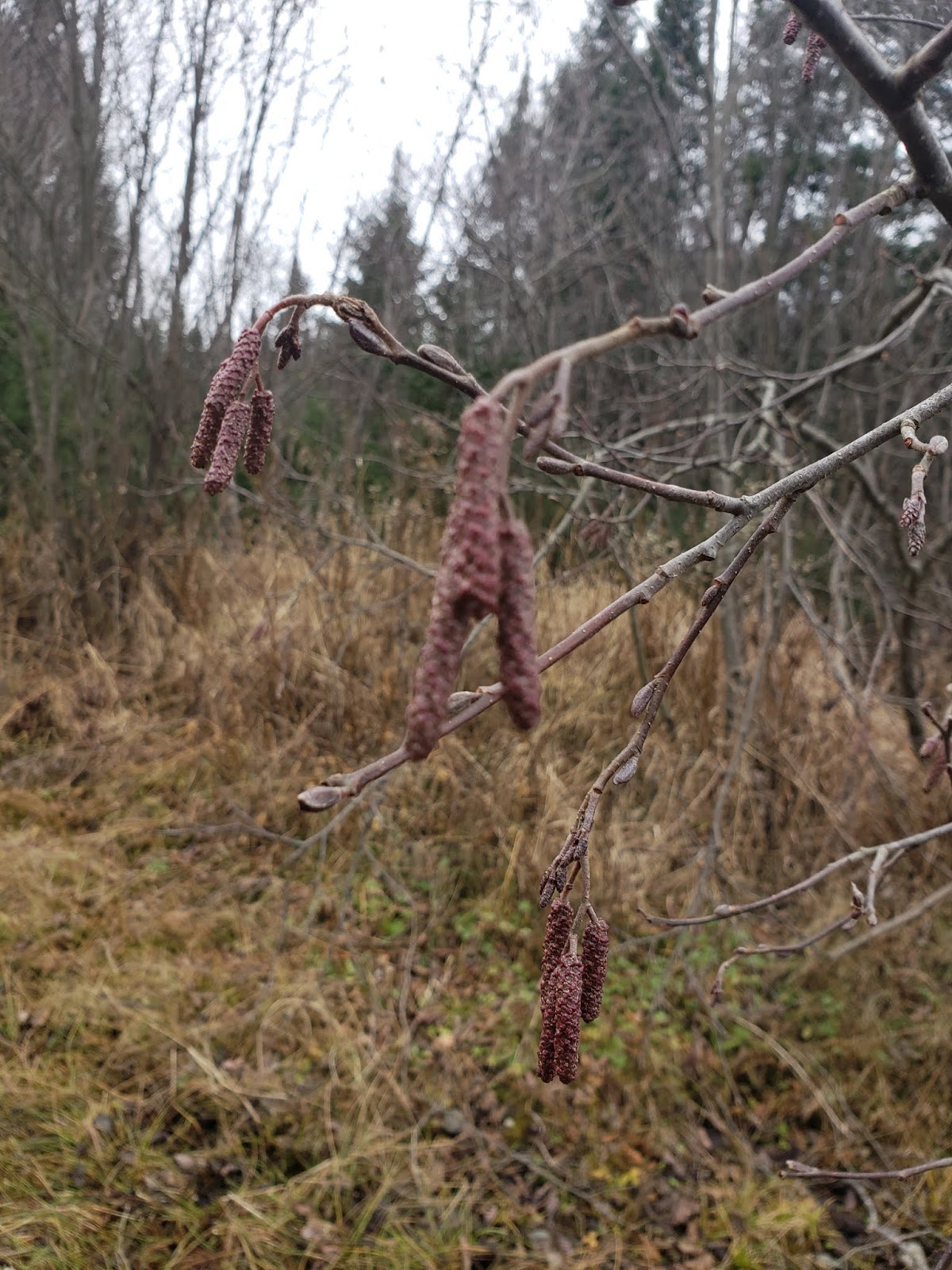
Alders
Any
serious New England upland hunter recognizes alders from a long ways off. An
alder patch with weeds and ferns between the stems is very likely to hold
woodcock and grouse are often found nearby. If the ground is choked with grasses
the likelihood of woodcock is low.
Alders
like wet country, but can grow almost anywhere. Around recently used logging
yards you’ll often find them crowded against the woods or the new cutting. Grouse
are often nearby.
The
Ruffed Grouse Society recently published an excellent article on the importance
of alders. Below is a link to it. If you are not a member of the Ruffed Grouse Society please consider joining.
![]() |
| Alder catkins. |
![]() |
| An ancient apple tree crowed by alders, it doesn't get much better than this. |
Wednesday, December 4, 2019
Early Wet Snow
![]() |
| Snow on high bush cranberries. |
Gray
skies dribbled wet snow, which mixed with the soggy ground. The weeds that
still stood readily soaked clothes. The dogs didn’t mind any of it. They were
happy to hunt and loved the conditions.
It
was the last stretch before we turned the woods over to the rifle hunters and
their search for deer. The morning temperatures had been down around or below
freezing and the days were noticeably shorter than a few weeks ago. The hills
bordering our valley looked soft, almost like supple gray fur.
The
grouse had scattered, the family groups broken up by hunters, human or
otherwise. Woodcock were still around and a lucky hunter could find flight
birds in numbers, or none. Soon they would all be gone. Depending on the year, grouse might be around apple
trees or mountain ash or high bush cranberries. This year every fruit bearing
tree produced massive crops, so the birds were scattered.
With
the season winding down we decided to spend the morning in a favorite old
covert. The cover has changed from alders to poplar to mature poplar, but it was
still a favorite covert that always has birds. A few ancient apple trees hid in the mix, always hinting of grouse..
| The ground was soggy everywhere.. |
The
ground was soaked and almost immediately a woodcock fled ahead of one of the
dogs. Down the hill we hunted and then turned northward when the ground turned
to bog. On small hummocks covered with young maples each of the dogs pointed a
woodcock. When Maggie points Colby always honors, I wish the opposite were also
true. Some easy shots were miffed, but during the next hour two connected.
| Colby pointing a woodcock hiding in a nasty thicket. |
Working
our way back by a couple of old apple trees another
woodcock was found, but no grouse. Often they are there, but not that day. Near the truck bird scent aroused Colby’s interest, but after some serious tail wagging she abandoned it.
Maggie trotted over and snapped onto point. On second thought, Colby decided to
honor.
It
was a thicket impossible walk into. Kicking against the side, the woodcock
almost smacked me in the face on the way by, then wove its way downhill through
the trees.
Two shots never touched a feather.
With
clothes soaked it was time to leave. The dogs slept on the drive home while I
sipped coffee.
The
bird season is just too short.
Saturday, November 16, 2019
Two Inches of Snow
| The cover looks so different with the leaves gone and snow on the ground. |
Temperatures
dip into the teens at night. Snow cloaks the ground and distant hills can be
seen between the gray trunks of bare trees. Winter is sneaking into the woods
and the world is changing.
Our
favorite coverts on the hillsides are empty. Woodcock are nowhere to be found.
Most of the old apple trees have shed their apples, but a few trees still cling
to their fruit. In the cuttings high bush cranberries glow red and can be
spotted from a distance. Mountain ash that were so easy to spot a month ago
seemed to have disappeared.
![]() |
| Sometimes the birds are hard to find. |
Bucks
have rubbed the bark off of small trees. Deer and moose tracks crisscross the
snow. Turned up leaves and soil mark scrapes where testosterone charged males
attempt to attract the opposite sex. It is a different world than a month ago.
Down
in the stream bottoms, where softwood trees edge the cuttings, grouse will be
found. Often the dogs will point with confused looks, uncertain of where the
grouse are, only to have the grouse launch from a tree, sometimes from
unbelievably high. Occasionally birds will be pointed on the ground, but most
of the birds have seen a hunter or two and will try to sneak away. The savvy
dog will learn to deal with the runners, cautiously pinning them rather than
flushing the wary birds.
![]() |
| Maggie pointing a ruffed grouse. |
Subscribe to:
Posts (Atom)