Showing posts with label grouse cover. Show all posts

Sunday, January 26, 2020

Looking for the MotherLode…


The end of October had arrived and the gang had left. It was prospecting time, which means searching for new grouse cover. It’s done every year, usually after all the friends have left. There’s no use dragging them around the wilds to places that may or may not hold birds. Sometimes the terrain gets mighty rough in our rugged neck of the woods and exploring what might be birdless cover isn’t always appreciated. Good grouse cover can go from prime to thin-pickens in about ten years, so it is always necessary to be prospecting for new coverts.
      The clear cut showed up on Google Earth and was back in a section of country that’s been full of grouse the last few years. The cut covered probably two hundred acres, but hid behind a stand of thick softwood trees, so it wasn’t readily visible from the logging road. All that, and fourteen miles from the nearest asphalt in some mighty rugged terrain made it seem promising and maybe even un-hunted.
      It would be one of the last hunts of the year, so I let all three dogs out for the hunt. Pandemonium can be fun. From where we parked a skid trail turned into snowmobile road, wide as a thruway, that seemed to run upward forever. It passed softwoods to the left while a stream gurgled in a gully filled with hardwoods to the right. When the softwoods gave way the cutting looked enormous. We trekked to the top and an old road continued into the shade of mature hardwoods.  The view back across the forested valley was stunning.
The nearest paved road is over those hills.
      The cutting probably was two years old with relatively easy walking between the poplar and maple sprouts. The loggers had taken away all of the tree tops, leaving the ground relatively clean. Wet spots were covered with grass and moose tracks. Sprouts crowned the hardwood stumps, but most weren’t shoulder height. Wild raspberries grew everywhere. It really wasn’t good grouse cover yet.
      The dogs and I hunted along the top of the cutting and then down the west side.  It didn’t look too encouraging, with no softwoods to offer shelter for the birds, but ahead and about halfway down the slope I could see softwoods left behind by the logging operation.
      Approaching, I noticed a small knoll covered with softwoods.
      Now I love knolls, because grouse love knolls. What better place to sit and collect morning sunshine and survey the surroundings. No matter which way danger approaches, the grouse has a downhill escape route that leaves them out of sight in the blink of an eye.
 
Chara on a bird.
    About then I wished my friends hadn’t all left for those flat lands to the south. Approaching the hump the dogs’ bells eagerly rang. And then I could hear the birds accelerating off the far side. There were at least four. If only someone could have been standing on the far side, it would have been like one of those European driven hunts.
      On the other side of that little hill the cutting opened up again with scattered softwood clumps further down the slope. Stopping for a moment, I tried to guess where I would go if I were a grouse and picked an open alley that led downhill into a softwood swamp.
      At the edge of the spruce and fir thicket my oldest German wirehair, Chara, locked up on point, almost completely hidden by young waist-high fir trees.
      A bird busted out wild.  Missed. Opening the gun to reload, a second bird rocketed after the first.
      Encouraging the dogs on, Colby, my youngest wirehair, pointed a grouse sitting about twelve feet off the ground in a yellow birch.  It flew on my approach, sailing away ahead of a swarm of shot…those birds coming out of trees are devilishly hard to hit.
      The woods got thicker, with blown down fir trees and nearly impenetrable clusters of young ones. Pushing through, it was impossible to see my feet. All three dogs became birdy, pressing under the tangles that I was forced to climb over.  Each dog wanted to find the birds first.
Colby coming out of the
thicket with the bird
Georgia pointed.
      I couldn’t locate Georgia, the young German shorthair, but then spotted her frozen about eight feet in front of Colby, who was honoring. The thick green fir boughs almost buried both of them. Before I could get within twenty yards of the dogs the grouse rumbled upward and a reflex made my gun fire. It was a prayer shot, but I saw a bird’s wing flutter…maybe. With the softwoods so thick a dead bird might get caught up in a branch and never hit the grouse. The dogs had disappeared.
      And then Colby came pushing through the brush with the bird in her mouth. What a great sight.
Georgia checking out the
grouse she pointed.
      We hunted down the hill, moving three more grouse, but killing none. Coming out of the swamp into the more open clearcut Chara pointed and a woodcock flew up on my approach. Twisting among the branches of two fir trees, it quickly escaped.
      We went back the next year and I brought my friends. I wish all my prospecting trips turned out that successful.


The gang, Georgia, Colby, and Chara, taking a break
beside a logging road.


Tuesday, November 5, 2019

That First Kiss


     Have you ever noticed how often you are driving past a place and think “that looks like great grouse cover”, and when you hunt it there are birds galore. You come back as second and third time to that same spot and it doesn’t measure up.
     About three weeks ago I stopped on a logging road out in the middle of nowhere to look at a map and figure out where I was. The woods on the uphill side of the road looked like it had possibilities, so I wadded in. The dogs picked up scent immediately and within five minutes there were two points and a third grouse flew out of a tree.
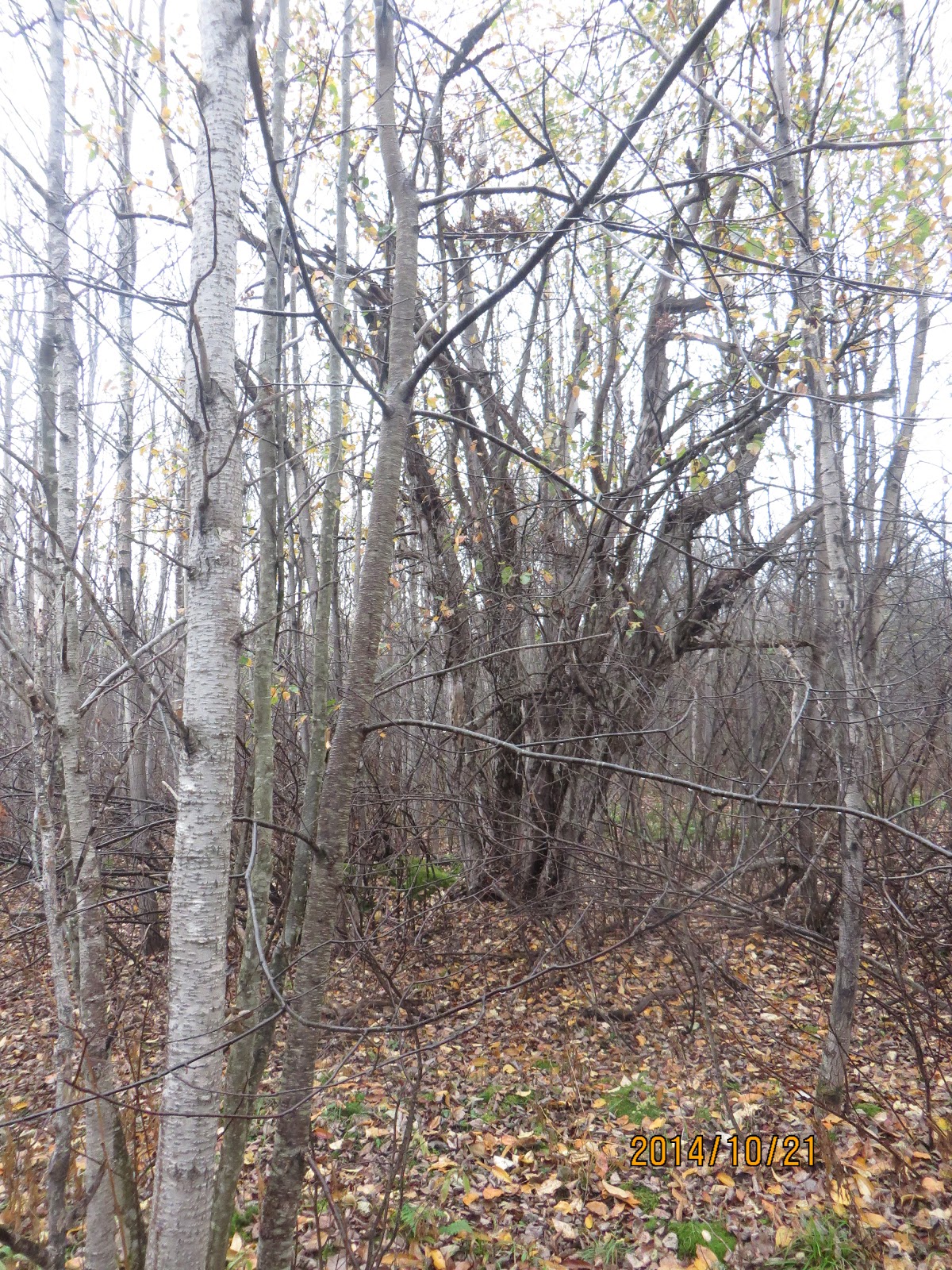
A young alder stand.
     There’s a place I have been driving by for years, an old clear cut filled with young pin cherries. That is not my favorite grouse cover. Passing by it a couple of weeks ago I noticed the pin cherries had been crowded out by poplars and alders. I pulled over and got out my gun.
     In an area of about two acres I moved eight woodcock and one grouse. A few days later I took a friend there and we couldn’t find a bird.
A sure sign of woodcock.
     Last year I hunted the regrowth in what used to be a gravel pit. Alders and poplar held a lot of promise and we found birds. Every trip since then had been a disappointment.
     Of course there are covers we find that produce over and over again, but there seems to be a high percentage that produce only on the first visit, only to disappoint later on. Or maybe we just remember it that way, the first is always best.
     Kind of like that first kiss.

A ruffed grouse hiding in a tree. He is safe from me.


Monday, April 23, 2018

Old and New


     We live about as far north as the early farmers ever tried to work the earth, at least in New England. Most left not long after they started and there never were a lot of them, but occasionally an abandoned foundation or old stone wall is stumbled upon.
     In 1815, the volcano Mount Tambora exploded in the Dutch East Indies and set off a global weather anomaly that caused the summer of 1816 to be known as The Year Without a Summer. That June it snowed six inches in many parts of northern New England and it didn’t melt for a week. The event convinced many that farming this far north was impossible.
An apple tree gone wild.
     So the abandoned farms are few and far between. We find them occasionally, usually with a few apple trees nearby and maybe a stone wall or foundation. The bears do a number on the apple trees sometimes, but those old trees are tenacious and wild ones abound. Abandoned fields in the forest are called openings by the locals, and every year the openings grow smaller and rarer. High bush cranberries, poplars, and blueberries creep in, soon followed by spruce and fir trees. Those left-behind openings can have some excellent grouse hunting around the edges.
     Up here, the more common grouse habitat is logged over country that is rebounding. Usually an area will provide good grouse hunting a few years after it is cut, until the trees are twenty years old or so and starting to mature. Throw in a few softwood trees for shelter and a stream, so the grouse can pick at washed up gravel, and that cutting is going to hold grouse.
     So up here we study Google Earth and tramp all over the place looking for grouse around these cuttings. I like to follow the edges, particularly if poplar and maple are growing and softwoods are close by. For reasons that I have never figured out, if choke cherry is the predominate specie coming up there seldom are grouse. High bush cranberry, blueberries, raspberries, and mountain ash are a bonus.
     Imagine my surprise when the edge of a clear cut led into a stand of wild apple trees, some of them thirty feet tall, with spruce and fir trees, red twig dogwood, and young maples mixed in. It certainly looked like an abandoned orchard. Some areas even had patches of grass remaining. The nearest paved road was seven or eight miles away, and the nearest gravel road half that.
My old girl Chara on a grouse.
     And there were grouse, lots of them, and even a pair of woodcock.
     A wide circle through the apples brought me back to the edge of the clear cut where stones shrouded in moss had been arranged to make a small foundation and a rock wall hid beneath leaves and lichens. Kicking fallen leaves around produced a rusty barrel hoop, but nothing more. Maybe someday I will go poke around again.
All that remains of a homestead.
     I am sure others have found that covert where new cover sits next to old, but I’m not likely to share it with many. It is a rare gem indeed.

Thursday, December 7, 2017

Upside Down

Can  you see Colby pointing?
      Regenerating clearcuts make for great grouse hunting. Certain things make some better than others. I like to see young poplars coming up. Maples and birches are good too, but if there are young choke cherries I usually pass it by. Softwood trees nearby are important for shelter too, but it doesn’t take many. Grouse will walk a long way into a cut, from the shelter of softwood trees, so be sure to hunt quite a ways into the cut.
      Some clearcuts are almost impossible to walk through from the slash left behind. Others are easier if branches and tree tops were hauled away with the wood. In our area almost none of the ground is flat and the logging roads tend to be in the valleys. The best hunting if often at the tops of the cuts, because the birds see fewer hunters and frequently there are stands of softwood trees at the higher elevations. So you had better be in shape because climbing those clearcuts can mean hard walking.
      When you find a productive cutting and hunt it over the years, the trees get bigger and you probably don’t notice the changes. But one day you will realize the place isn’t what it used to be. It is because the forest became too mature and the nesting areas and food sources are gone. Grouse and woodcock are birds of the early successional forests.
There is even an old stone
foundation nearby.
      So besides hunting grouse, you continually have to hunt for new cover. If you don’t you’ll soon be finding fewer birds.
      This past fall we stumbled upon a new favorite. A logging road will take you up above the clearcut and then it is only a hundred yard walk down a gentle slope to reach it. Better still, the loggers left behind a few ancient wild apple trees that had been hidden. There is an assortment of weeds, water is nearby, and stands of softwoods break up the landscape. Clusters of young alders, the diameter of shovel handle, stand like tall skinny commuters waiting for the bus. The place is going to be a good one for several years.
     No, I won’t tell you where it is.
Maggie is pointing a woodcock.


Thursday, June 18, 2015

The Back of the Mountain

Big country.
It is way back in the woods, almost twenty miles from the nearest pavement. About twelve miles in, all of it on logging roads, a gate blocks a side road. That gate has been left open on occasion and if you pass through it the road starts to climb.
Every serious grouse hunter is always looking for new cover, and most of us are looking for that out of the way spot that others might have overlooked. Arial images of that country showed a winding gravel road that climbed up over the shoulder of the mountain, then dropped down into a tight little valley to cross a stream, and then abruptly climbed back up another ridge. Up on the high ground, cuttings abut softwood stands, making for decent looking grouse cover, at least in the pictures shot from space. Only boots on the ground could confirm it.
My first attempt to drive in there stopped after crossing a height of land and then dropping down into the little valley, which is almost a gulley really. The wood bridge over the stream didn’t look too rugged, and, far in the woods alone, I chickened out.
Prospecting for grouse.
This past fall I drove in there with a friend. That rickety bridge had been replaced, so we traveled on. The road climbed up out of the valley, eventually leveling out next to a softwood edged cutting. Alders lined the road’s edges and young poplars sprouted everywhere. Enough grass grew in the road gravel to let us know that very few people traveled there. We found a place to pull off, let out the dogs, and dug out our guns.
The day was bitterly cold, but we found a few grouse. The shooting was tough, as it often is in cuttings. It looked like excellent woodcock country, but we found none. I’d bet a week’s wages that they nest in there though. When the sun poked out between the clouds and the gusts of wind dropped in a lull, the day actually felt nice, but most of the time I wished for one more layer of clothing.
After chasing a couple of grouse in circles and my friend killing one, we drove up the road further, crossed over another ridge, and then dropped down into another valley that seemed to stretch out forever. The road eventually deteriorated into two slippery clay-filled ruts that followed a stream on our left. When the road became just awful, we turned around. 

Don with a grouse.
About halfway back up the backside of that mountain we stopped at a four way intersection to eat lunch. A logging road to the north more or less followed a contour line along the edge of a cutting, so after eating we hunted it.
Saplings the size of my wrist filled the cutting above the road, but most were no taller than I. Moose had browsed the area heavily, stunting the young trees and holding back the regeneration. It was pretty country though, with a series of ridges to east that ran off into the neighboring state. We found no grouse, even though the hillside held promise. The rocky rough ground and left-behind slash made for touch walking, for both us and the dogs. Rugged men must have logged that country.
Exploring new country.
Back at the truck we swapped the two older wirehairs for the younger shorthair, Georgia. The road to the south passed through mature hardwoods with a stream grumbling in a valley to the left. Around a bend an old cutting held young maple, poplar, and softwoods. We hunted up through the cutting, moving one bird. Dropping back down and intersecting the road again, Georgia went on point. The grouse leapt off a precipitous drop-off, much like a paratrooper leaves an airplane, and disappeared down toward softwoods surrounding a stream below. My buddy’s pellets shredded the bark on a half dozen saplings, but not a feather drifted in the air. Georgia went down the nearly vertical embankment, like only an athletic dog can, to search the ravine but found nothing
We hunted more of that cutting and moved one more bird. It is good looking
Georgia.
country and I bet it seldom visited. It’s worth another look someday when that gate is open again. If it’s open at the end of the next summer, it will be a great place to train our pup on woodcock.
Now I have this phobia about getting stuck back in the woods somewhere. In my younger days, when I worked logging, three foresters parked their truck in the woods about thirty-five miles from the pavement, did their day’s work, and then came back to a truck that would not start because the headlights had been left on. I often think of that out in the middle of nowhere.

My truck started fine and our trip out of that wild piece of country was uneventful, which is just the way I like it.