Saturday, April 2, 2016

Spring is Here

Maggie running back after flushing the woodcock.
    A cool wind blew from the east under a blotchy gray sky. Small mountains to the east showed the scars of logging and patches of white lingered near the tops of the highest. The two older wirehairs dashed ahead, familiar with the old logging road, having walked it dozens of times over the years, both hunting and just to be outdoors.                 
    Maggie, our twelve week old pup, stayed closer, walking in the drainage ditch and fascinated by the flowing water as only a puppy can be.
    Up from under her nose tweetered a woodcock, the first one seen this year!
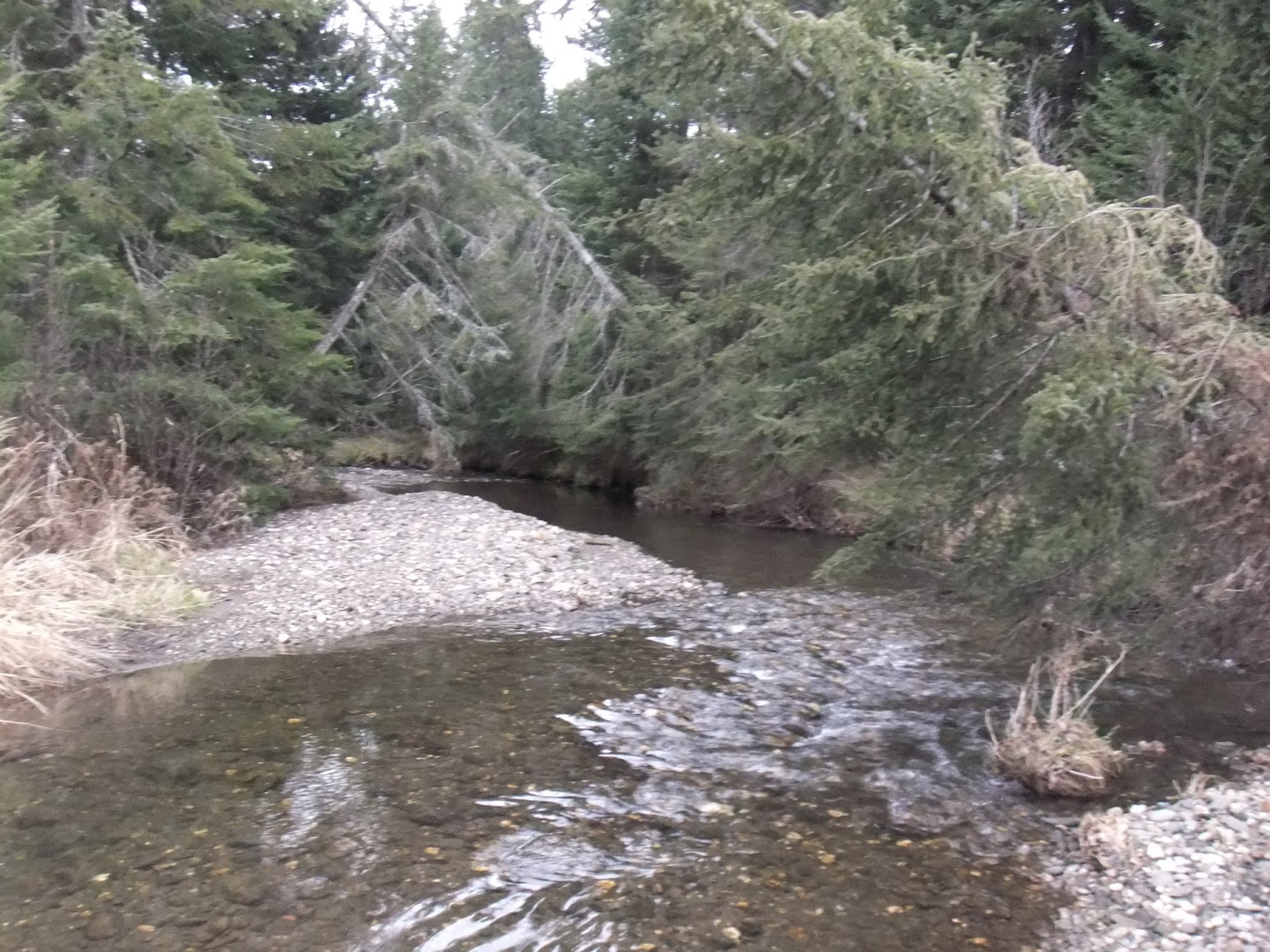
A new beaver pond flooded the road.
    Maggie dashed back to sit by our feet and watch the bird fly away.
    After hoots of laughter and praise for the pup, we carried on. Further down the hill a grouse flushed wild, twisting like a calendar painting through the barren poplar and birch. Life felt pretty good.
    Further on, up in a cutting, Chara, the older wirehair soon to turn fifteen, pointed with Colby backing, but no bird was found, yet was still a delight to see.
    Later, almost back to the truck, Chara shuffled around inside a thicket of alders. Pause, snort and sniff, pause, point, shuffle and sniffle…no style, but with determination, and up went a woodcock. That made two!!!

Lounging at Camp Grouse while listening to the grouse drumming.
    On the way back to Camp Grouse, the sun poked through the clouds and the subject of a beer came up. Later, sitting on the deck, we clicked the necks of two bottles together in a toast to spring, and almost immediately the season’s first drumming from a grouse drifted down the hill.
     

Tuesday, March 15, 2016

Waiting For The Woodcock

    Snow lingers in the woods. Pockets of white hide in the shadows of trees and rock-like ice fills the hollows. Beneath blankets of white, north facing slopes still sleep where the air remains icebox cold.
    But the slopes facing the sun are welcoming her warmth. Swollen streams rush down the hills, creating a rumble that seems to be everywhere. Songbirds chirp and flit about, shyly hiding in the softwoods, busy with courting and spring tasks.
    The bare fields have been invaded by cackling geese, cackling about whatever geese cackle about. Soon after dawn, high in the sky, a pair honked their way up the valley, causing even the dogs to stop and listen. Blue skies and warm breezes make promises we hope are true.
    A walk down along the stream finds the ground cement hard in the shadows of the softwoods. Even amongst the sunlit alders it is the same. Undaunted, the dogs make the effort, searching the ground thoroughly. No woodcock or grouse in a covert that often has both.
    Circling back, up the bank where the sun warms the earth, the bare ground is soft. Eager noses search for the scent of returning woodcock. Optimism grows with the heat of the sun, but too soon the cabin comes into view.
    We’ll have to try again tomorrow.

Sunday, February 21, 2016

Waiting for the Drum Roll

   Rain falls and snow melts. It is early and perhaps winter is not over, but shrinking snow and song birds chasing each other in lust says it is. The last snowfall had the heft of spring snow, not the downy consistency of a winter storm. Enough bare ground exists for the woodcock to have returned, but the ground is still frozen hard and the likelihood of their proboscis poking into the soil to find the necessary protein is unlikely.
     The dogs sleep. Waiting is easy when you sleep. Soon the woodcock will return and during the early weeks, before their nesting season, the dogs will search them out to point a few, which is great early spring fun.
    Melting snow causes hurrying flooded streams. Trout fishing will come as the water slows and returns to the confines of its banks. Flies can be tied in the meantime. Down by the stream below the house a grouse flushed a few days ago, leaving behind tracks in the snow. Fly fishing passes the time between bird seasons and gives an excuse to search for grouse and woodcock cover.
    The rain continues. Neither dog has moved for hours, even when a log shifted and clunked in the woodstove. It is easy to envy them.
    When the rain stops and going outside is again a possibility, maybe a grouse can be heard drumming.


Sunday, January 24, 2016

Winter

    Eyes the color of winter sky look up questioningly. A rubbed ear brings her chin to rest against my knee. Eventually, she settles to lay on the rug by the desk, curled up in slumber. Soon, her legs twitch in a dream.
Chara in her fifteenth winter.
    What a long life she has had, hunting fifteen seasons, and most of those in some of the finest ruffed grouse country found anywhere. The dreams must be shaped by memories from those fifteen autumns. What stories she could tell.
    Daily walks in the woods keep our weary legs in shape, but the winter, with its deepening snow, makes the going impossible for dogs. Plowed logging roads are the only place for them to run. There she can still sniff the air along the sides, searching for grouse. Her loping trot rocks her along, but the occasional slippery spot causes the hind legs to fumble. Up and on again, her spirit is unfazed.

   In a little over two months the woodcock will return. Let’s hope we both see our way through Mother Nature’s next cycle. Do we dare dream of one more fall together?

Chara with Colby backing.

Friday, January 1, 2016

December Ends….

    The ankle-deep snow muffles the sound, our feet fall silently. Up the hill the dog’s muted bells ring. Everything looks different, blanketed by six inches of white, and the usual way is lost among the softwoods. Steeper terrain over dozens of deadfalls finally leads to the old tote road cut into to hill.
     To the left leads to favorite country where memories have accumulated over the last decade. Who would have dreamed that Chara, my older wirehair, would still
be hunting the last day of her fifteenth bird season? Colby, younger and with longer legs, is unfazed by the snow. Chara works harder, in a rocking horse motion, but appears to be having the time of her life. How many years have I wondered on the last hunt of the season if it might be the last hunt of her life? What a life she has had.

     The trail leads past softwoods and a small cutting to a gurgling brook, which is a likely place to turn around and head back, but the softwoods beyond beckon. Beneath them the snow is less deep and covered with rabbit tracks. Colby hunts further toward the edges while Chara scours the sides of the old way. A deer walked that way earlier and dozens of tiny tracks create a puzzle. Beside the lane a moose has scarred up dozens of maples, probably the same moose that Colby startled in the driveway a couple of months ago. Further up, where the old road forks, the top of a giant wild apple tree had been broken up by a bear. Not a partridge track had been found.
    Chara seems fine, but I worry about her. After I clear the snow from her bell, we head back. Downhill is always easier. The dogs hunt just as hard as they did on the way up.
    A different path leads back the final stretch to Camp Grouse. Still not a grouse track to be found. The dogs don’t seem to mind, they love the sound of the bells and the rituals of the hunt as much as the kill I think.
    I do too. 

Monday, December 7, 2015

Something to Think About….

I’ve been down that sad road with blown CCLs in my spayed German Wirehair. Dogs play a big part in the life of bird hunters and become part of our families. It is time to reconsider neutering, even though some of the veterinarians are dragging their feet….


Sunday, November 1, 2015

Rain

    Little is good about hunting grouse in the driving rain. Even dressed in the best foul weather gear, the thick cover, which grouse love, gets heavy with water to make walking difficult. Soon, struggling hunters soak through from perspiration, no matter what the maker of the rain gear promises. And it is possible to sweat profusely while your hands freeze, if the temperature is close to freezing.
    Seeking shelter, the grouse sit tight among the boughs of softwood trees. The rain flushes away scent, making the dog’s work nearly impossible. In the country we hunt, the puddles form quickly making the ground a soft sponge. Grouse hiding in the branches of spruce and fir trees are mighty hard to find.

   The best thing about hunting grouse in the rain is a bowl of chowder or chili at the diner down the road. Or maybe it’s the dram of amber liquid back in the camp at the end of the day.

Tuesday, October 20, 2015

A Secret Place

In the shadows of the softwoods a small stream twists though the valley. On the east side of the narrow basin a four year old clearcut promises young buds, plenty of cover, and abundant seeds and fruit for grouse and song birds.  To the west a slightly older cutting provides shelter for nesting birds, with a forest so dense that marauding goshawks would have a difficult time weaving through the pole-sized young stems.
The song of the water is constant.
During a hot day, in a bird season a few years ago, that little ravine provided an abundance of partridge. The weather had been unusually warm for days and elsewhere the grouse hid in places the dogs could not find. Blown down firs and spruce slowed the hunt and clothes heavy with perspiration stuck to the skin to make walking a chore. The oldest German wirehair shared that special spot that day. Thundering wings wiped away the heat, lightened the sticky clothes, and provided a path through the fallen crisscrossed logs.
That cold tumbling brook is narrow enough to leap across in several places, yet deep enough to hide colorful brook trout that live amongst the shadows of spruce and fir roots. During hot summer weather the shade provides relief and the water cools the air. Tiny trout flies worked through the watery shadows can catch tiny wild brookies, but the canyons and caverns between the roots will break off the fine leaders required to fool them.
It’s a hidden place, visited by few. Sometimes, on a hot day summer day, I’ll let the dogs splash about to their heart’s content in the shadows of those softwoods. And if it is hot enough, one larger pool, with a bottom of fine gravel, is inviting enough to tempt me too.
But it’s October and it has been warm, so it’s time to visit that secret place again where the grouse like to stay cool.

Tuesday, September 8, 2015

My Old Girl

Chara sleeps at my feet, the old dog’s body twitching in a dream. The Lord knows she has plenty to dream. Her life has been a full one.
We learned to hunt grouse together, each of us in our own way. I supplied quail and pigeons and made certain to spend plenty of time in the field, but it was hours in the grouse woods that made her a great grouse dog. There is no way I could have taught her to track and point, then relocate as the grouse tried to sneak off.
She learned where the birds were, then searched the cover they preferred and the places they hid. Weather never fazed her, except when it turned hot, but I never liked hot weather either. Often I’d call it quits on a cold rainy day long before she wanted to go home.
Those snotty setter snobs might cringe watching the way Chara followed foot scent, but I learned a long time ago to be patient. Just as the Royal Canadian Mounted Police used to always get their man, she always found her bird. Bumped birds were rare because somehow she sensed the bird’s temperament and skittish birds she would sometimes point from sixty or even a hundred feet away.
A friend and I were following Chara through some softwoods in a valley that shall remain anonymous. Climbing up on an almost shoulder-high boulder, she pointed upward. The conversation went something like, “Do you suppose there is a bird up there?” with both my friend and I craning our necks to see up into the limbs of a fir tree. We kicked the tree’s trunk, yelled and hollered, and sure enough a grouse flew away, unscathed of course. Chara went right back to hunting with a very smug look on her face.
Chara learned to love duck hunting.
She’s retrieved geese and more than a few ducks. Her love of water seems unfazed by temperature. Often she’s broken ice to lay in the water for no reason other than to get wet. Hunting the alder bottoms for grouse and woodcock during duck season I often loaded with steel shot, knowing Chara would readily retrieve any ducks I lucked into.
Her first real duck hunting excursion confused her. Why were we sitting and waiting with those carved wooden ducks out on the water? She fidgeted and fused, not at all happy. Shortly after first light a pair of mallards flew in like rockets and one fell to the gun. I looked down to say “Fetch”, but my girl was already in the water to retrieve that dead duck. After that one retrieve she sat still as a statue and waited patiently, her eyes ever searching the morning sky.
Dapper at five months.
My mind’s eye can still see her as a puppy pointing what turned out to be a pair of quail in a wildlife management area. It was her first hunt and at only five months of age. One of the quail fell to the gun and Chara instantly pounced on it. What a way to start. Steady to wing and shot would come later and then fade as she got older stubborn.

Last fall she hunted her fourteenth season. A week of gunning had been planned with multiple dogs, but when her turn came up it was just the two of us on a short hunt. Her hind legs are not strong anymore, but those easy hunts gave her the opportunity to point a couple of grouse.
Chara trailing a grouse.
Her last was a wanderer, which she trailed through a raspberry patch, across an alder flat, and up a slope through young maples. She locked up solid at the base of a knoll and I scurried ahead with leaves scrunching under my feet, only to have the bird thunder off as I crested the rise. I’ve replayed that hunt over and over in my head, and I think she has too.

Pointing a grouse in her 14th fall.
We are getting close to bird season again and physically she is exactly the same as last fall, so I’ll plan a few more of those short easy hunts in some of the best cover. I owe her a fifteenth season.


Chara at her finest.

Wednesday, August 12, 2015

How to Walk in the Woods

Ruffed grouse hunters are a peculiar lot and walk with an unusual gait.  This extraordinary stride carries them over irregular ground, past nasty thickets of twisted tangles, and transports them for hours on end across countless miles without hardly a stumble.
It takes years of practice, and possibly no one really masters it unless they start to develop the skill as a child.  The pace is rather rolling and loose, fluid, almost floating through the forest rather than pushing into it.  Grouse and woodcock cover is often thick and tangled, not to be traveled without due deliberation, so this skill is worth developing if at all possible.
Where's our truck?
As one walks their eyes should constantly scan ahead for the easiest course through the forest maze, but it must be done at an almost subconscious level or it would sidetrack the hunting experience.  Zigzagging around obstacles requires far less energy than wading through even the smallest thicket, and bending to walk like a crab under low limbs tires back muscles and thighs as well as creating a stance from which it is impossible to shoot. 
Of course, until it is truly subconscious, this struggle for surrounding-awareness is distracting, particularly if you are trying to keep track of your dog, the hunting partner that you started the day with, and where on the earth you actually are.  Keep practicing until you can do it at an intuitive level while doing other things, like trying to figure out why the batteries in your GPS didn’t last as long as you thought they should.
This brings up topography management, or, in layman’s terms, keeping track of where your feet are landing.  Again, it should all be with the same subliminal level of thought that you pick a path through the trees with.  Using your lower peripheral vision, watch for obstacles such as fallen limbs, mud holes, and interwoven weeds.  When you step in a hole and mud goes up to your knee, you will know there is still work to be done.
Stride control is another critical skill, particularly if one wants to avoid flopping down on your face regularly.  A foot should never be lifted off the ground until the other is firmly planted, and when it is lifted it should be brought well up so as not to catch on low branches, interwoven grasses, or twisted vines.  Each leg should be straightened for an instant as it carries the torso forward, which gives it a momentary chance to rest, albeit a short one, and as each foot rocks forward the hunter should ride it up onto the ball of the foot to stretch the step as far as possible.  A hurried pace will frequently land you horizontal and embarrassed, while a slower steady pace will carry a hunter upright for hours.
Where are we?
Falling is an art in itself.  Every grouse hunter trips or steps in a hole occasionally, and, unless it is a frequent occurrence, it should not be cause for concern.  Landing is the part to fret about.  At all cost, one’s gun should be held upward and off the ground.  Never use the gun’s stock to break the fall, which could have disastrous results directly proportional to the beauty and value of the walnut in the stock.  If the muzzle comes anywhere near the ground be sure to check for blockage, as ruptured barrels destroy a gun’s value, as well as fingers, and possibly eyes. 
An experienced faller drops loosely to the ground and sort of rolls to one side on landing, while all the time holding his shotgun upward.  Cussing is allowed.  Fortunately our dogs never report our clumsiness or even seem to notice it.  Remember, a broken arm will mend, but a broken stock never will.
Stamina comes easily for twenty year old athletes, but older hunters require a routine of regular walking to prepare for the fall season.  We are fortunate to live where there are areas of ample waist-high brush that one can push through to strengthen legs.  If a hunter is unable to locate similar terrain near his home there are alternatives.  A favorite is to fill two burlap bags each with about twenty pounds of sand and then tie a six foot length of rope to each.  Next, tie the free end of each rope around an ankle.  Walk around the backyard while dragging the bags of sand and soon the leg muscles will be firmed up and ready for the fall, and as a bonus the cardio vascular system will also be brought up to speed. 
If neighbors cannot see you exercising, carry your heaviest target gun with you to gain upper body strength, but if you live in a suburban area and are visible to strangers it is best to carry small dumbbells in your hands to avoid a visit by the local SWAT team.
To test your newly developed woods walking skills take your dog to favorite cover and let him loose.  Put on a broad brimmed hat and start to follow, just as you would on a typical bird hunt.  At the start of this trek though look at your watch, and then keep count of how many times your hat is knocked off as you follow the dog.  When you’ve had all that you can stand, and are hopefully are back at your vehicle, look at your watch again to see how many minutes you’ve been in the woods.  Then divide that number into how often you had to pick up your hat.  For every fall you took where a knee actually hit the ground subtract fifteen, and if you flopped out flat subtract twenty, unless you refrained from cursing, then only subtract nineteen.  If you stepped in a mud hole that went over your boot-top, subtract twenty-seven, but if you never lost track of your dog during the entire walk add thirty two.  If at any time a stick poked you in an eye so that the eye actually watered, take away another forty-one, but if you wore shooting glassed and they were only knocked off ad five.  The resulting number is your wood walking quotient. 
Any number below twenty-three means there is still work to be done.      
Finally easy walking.
      

             This piece of wisdom first appeared in RGS magazine. Please support that wonderful organization.  http://www.ruffedgrousesociety.org/


Monday, July 27, 2015

Sunday, July 12, 2015

A Quickie

    We’d had a full day and our tired legs enjoyed the ride back to Camp Grouse. Never quite sure how much guests can endure, I halfheartedly suggested one last a quick hunt in small covert that we would pass on the way home.
    Jim was game, but Peter’s ankles protested so he offered to wait for us. Old football injuries still plagued him.
    We parked at the beginning of a logging road near a stream, let out Colby, my younger German wirehair, and readied our guns. After walking across a logging bridge, we slipped into the alders.
Jim Kline in the alders.
Colby on a woodcock.
    Almost immediately Colby became birdy and then locked up solid beside the brook. But we couldn’t find a bird. We coaxed her on, only to have her stop a short distance away on the far side of fat old fir tree. Through the tangle of trees a woodcock spun upward only to fall to Jim’s gun.
    Only a few feet away Colby pointed again and that time a woodcock climbed spiraled like skyward like a rock only to tumble from my gun and fall within a few feet of Jim.
During the next few minutes we moved five woodcock, of which three came home with us. That covert is perfect, between a clear cut and alders along a stream, with scattered gnarly fir trees poking up over the cover.

A woodcock under Jesse's nose.
    Jim looked mighty happy as we climbed back up to the road, having rounded out his limit of woodcock. Peter smiled when he saw us, I’m sure happy for Jim and anxious to get home. With tired feet and hungry bellies we traveled on.

Tired girls at the end of the day.

Thursday, June 18, 2015

The Back of the Mountain

Big country.
It is way back in the woods, almost twenty miles from the nearest pavement. About twelve miles in, all of it on logging roads, a gate blocks a side road. That gate has been left open on occasion and if you pass through it the road starts to climb.
Every serious grouse hunter is always looking for new cover, and most of us are looking for that out of the way spot that others might have overlooked. Arial images of that country showed a winding gravel road that climbed up over the shoulder of the mountain, then dropped down into a tight little valley to cross a stream, and then abruptly climbed back up another ridge. Up on the high ground, cuttings abut softwood stands, making for decent looking grouse cover, at least in the pictures shot from space. Only boots on the ground could confirm it.
My first attempt to drive in there stopped after crossing a height of land and then dropping down into the little valley, which is almost a gulley really. The wood bridge over the stream didn’t look too rugged, and, far in the woods alone, I chickened out.
Prospecting for grouse.
This past fall I drove in there with a friend. That rickety bridge had been replaced, so we traveled on. The road climbed up out of the valley, eventually leveling out next to a softwood edged cutting. Alders lined the road’s edges and young poplars sprouted everywhere. Enough grass grew in the road gravel to let us know that very few people traveled there. We found a place to pull off, let out the dogs, and dug out our guns.
The day was bitterly cold, but we found a few grouse. The shooting was tough, as it often is in cuttings. It looked like excellent woodcock country, but we found none. I’d bet a week’s wages that they nest in there though. When the sun poked out between the clouds and the gusts of wind dropped in a lull, the day actually felt nice, but most of the time I wished for one more layer of clothing.
After chasing a couple of grouse in circles and my friend killing one, we drove up the road further, crossed over another ridge, and then dropped down into another valley that seemed to stretch out forever. The road eventually deteriorated into two slippery clay-filled ruts that followed a stream on our left. When the road became just awful, we turned around. 

Don with a grouse.
About halfway back up the backside of that mountain we stopped at a four way intersection to eat lunch. A logging road to the north more or less followed a contour line along the edge of a cutting, so after eating we hunted it.
Saplings the size of my wrist filled the cutting above the road, but most were no taller than I. Moose had browsed the area heavily, stunting the young trees and holding back the regeneration. It was pretty country though, with a series of ridges to east that ran off into the neighboring state. We found no grouse, even though the hillside held promise. The rocky rough ground and left-behind slash made for touch walking, for both us and the dogs. Rugged men must have logged that country.
Exploring new country.
Back at the truck we swapped the two older wirehairs for the younger shorthair, Georgia. The road to the south passed through mature hardwoods with a stream grumbling in a valley to the left. Around a bend an old cutting held young maple, poplar, and softwoods. We hunted up through the cutting, moving one bird. Dropping back down and intersecting the road again, Georgia went on point. The grouse leapt off a precipitous drop-off, much like a paratrooper leaves an airplane, and disappeared down toward softwoods surrounding a stream below. My buddy’s pellets shredded the bark on a half dozen saplings, but not a feather drifted in the air. Georgia went down the nearly vertical embankment, like only an athletic dog can, to search the ravine but found nothing
We hunted more of that cutting and moved one more bird. It is good looking
Georgia.
country and I bet it seldom visited. It’s worth another look someday when that gate is open again. If it’s open at the end of the next summer, it will be a great place to train our pup on woodcock.
Now I have this phobia about getting stuck back in the woods somewhere. In my younger days, when I worked logging, three foresters parked their truck in the woods about thirty-five miles from the pavement, did their day’s work, and then came back to a truck that would not start because the headlights had been left on. I often think of that out in the middle of nowhere.

My truck started fine and our trip out of that wild piece of country was uneventful, which is just the way I like it.  

Thursday, May 21, 2015

Even Grouseless Days….

    The drive in is about nine miles over a small mountain, across a timber bridge, and then it is then either left further into the wilderness or to the right and another nine or ten miles back out to a different paved road.  We went left.
     About another six miles up the road I parked in the same spot as a month and a half earlier.  The woods looked more open, with the weeds squashed down by snow that had come and gone.  With the naked trees not holding a leaf, the mountains across the valley looked much closer.
    Alders, half again a man’s height, covered an old logging yard there.  Behind them the land climbed gradually, covered with lofty hardwoods and dark old spruce trees.  Below the road young fir trees huddled together like cliques in a school  yard, each separated by open areas of bent and flattened weeds and grass.  Scattered maples and poplar sprouts remained upright, obviously unfazed by the earlier snow.
    Chara, my German wirehair pointer, pranced a few steps from the truck and locked up on point, her nose aimed directly into the nearby alders.  Hurrying shells into my gun, a partridge burst upward and disappeared into the boughs of spruce trees.
    We hunted behind those alders, more or less parallel with the road, and then crossed to the lower side, drifting between the clusters of fir trees.  About the sixth clump Chara’s hind end went into over-drive and then she froze, pointing into a tangle of green needles and gray trunks.   In the dark shadows a boulder poked out of the earth, nothing more. Walking around the left side of the trees, the partridge thundered out of the right, a sound unseen.
    The scenario was played out again, and then again.  Two hunters might have shot some birds.
    Chara slowed and then pointed into a cluster of limby firs. Bright green moss muffled my footsteps.  A partridge that looked the size of a turkey launched under my nose.  Reflexes brought the gun to the shoulder and a finger slapped the trigger, just as the bird ducked around a yellow birch trunk. I’m sure the tree survived. 
     I swear Chara struggled to contain a laugh.
    A bird flushed wild from a thicket of raspberries, and another was pointed on the way back to the truck, but both escaped unscathed.
Unloading the gun and putting it into the truck, I congratulated myself on the valiant conservation effort and the breeding stock that I had left behind.  Chara looked quite proud of herself, as she should with about a half dozen successful points. 
    Another spot further up the road deserved the same treatment.  There, the thick new growth of a fifteen year old clearcut covered the hillside.  Chara plunged in and I followed, as best I could, along wet and lumpy skid trails.  We didn’t find any birds and, if we had, shooting would have been impossible in that thicket.  Eventually our course brought us back out to the logging road about a half mile from the truck. 
    We dropped to the lower side of the road and worked back between the road and a roaring mountain stream.  Nearing the truck Chara’s hind end went into overdrive and, with her nose scouring the ground, she obviously followed a traveling grouse.  The trail went through thick grass, under clusters of young fir trees, beneath a blown down dead fir tree, directly over the top of an automobile-sized boulder, across a log, back into a cluster of waist-high fir trees, and then into raspberries that contained claws like a bobcat. Chara looked determined and optimistic.
    About fifty feet ahead of us, at the edge of the logging road, old Mr. Partridge decided he had enough of those two cahoots following him and took off over the road, to never be seen.
   It was a fitting time to end another memory filled day.


Sunday, March 22, 2015

Looking For Woodcock

    Where the sun hits the ground greasy mud squishes under my feet. The dogs don’t even notice it, but bound into the woods. Under the trees mounds of snow blanket the ground, so the trail makes for much easier walking.
    We’re hunting. The dogs know it, plowing through the brush, ever searching, even though there are no guns. Friends have found woodcock in that same area during the last few days, so we are searching.
    The young shorthair, Juno, is covering the most ground and I wonder if she’ll point or bump the birds. The younger wirehair is more methodical, tending to business, tail wagging and happy to be out. A week ago deep snow made covering this same country impossible. Chara, searching for birds in her fourteenth spring, doesn’t wander far from the old roads, but stops often and sniffs the air. It wouldn’t surprise me if she found a woodcock first.
    The howling north wind has a bite, so the collar is turned up and earflaps are pulled down. Bright blue sky stretches across the sky, but the sun lacks warmth. Where matted grass covers the ground, the earth feels like cement from the lingering frost. The air smells clean, almost metallic, free of pollen and the soon to come scents of green things.
    A series of left turns brings us in a circle. The dogs hunt with determination. Wherever the woodcock are, it isn’t in those old brushy fields or along the edges of the woods. In the shade of ancient white pines an old tote road takes us back to the truck.
    The dogs will dream of woodcock tonight, and so will I.

Saturday, March 14, 2015

Waiting on Woodcock

    The blanket of snow has withered to dirty mounds and rain is creating huge puddles. Our dogs pace anxiously, hoping someone takes a walk them among the fields out back, but they finally have resigned themselves to laying in my office beneath my desk and chair. On a walk earlier, the first patches of bare ground remained frozen and felt like concrete.

    Maybe tomorrow, possibly the day after, or a least sometime soon, the woodcock will show up again. They will do their mating dances over the fields out behind the house and then hide among the weeds along the edges. On the morning walks the dogs will find their scent and point them.

    Spring will have arrived.

Sunday, February 8, 2015

Camp Grouse

    Camp Grouse is a dream perched on a knoll. Around this knoll the land rises, creating a nearly empty valley, where a stream constantly serenades and a breeze funnels regularly between the hills. Clouds of warblers swarm the trees in June and dragon flies patrol the yard on August evenings. Grouse drum in the woods come March and the forest becomes a riot of color come September. During the winter months there is a pristine silence, as the snowy world sleeps before repeating the cycles.
Dreams of spring.

    About the time the snow disappears and the streams swell, dreams turn to trout fishing. The mighty river, a mile or so away, holds larger trout, but the small stream down the hill from Camp Grouse is full of native brook trout. Every spring the brook is different, with the snow’s runoff carving a new course and recently fallen trees always crisscrossing the stream. The new logjams and undercut stream banks will create deep dark holes where the brook trout will hide. Hopefully, a few will be coaxed out to fry in bacon fat for breakfast.
Dreams at the vice.
    Upstairs at Camp Grouse, inside the big pine desk, is everything imaginable to tie trout flies. Books on patterns and trout sit atop that desk, and the hours slide away there, tying and dreaming. It really is as much fun as fishing.
    Hiking books and maps, stored in the bookcase by the stairs, help plan our short expeditions. When the weather is nice during the summer months, our daily hikes keep both the dogs and us in shape, and so far we haven’t run out of new places to explore.
    In stormy weather, or even with the morning coffee while waiting for the sun to climb higher, there is usually a jigsaw puzzle in the works on a card table beside the sliding glass doors. Bookshelves are filled with hunting and fishing lore, along with favorite novels and books on New England history. Upstairs a guitar waits to be picked. A rainy day certainly isn’t a hardship.
Friends helping.
    As September winds down clay targets are launched from the deck to be turned to dust as they sail out over the alders at the bottom of the knoll. Come the first of October the dogs will lead us into the vibrant fall foliage, their bells ringing and enthusiasm never wavering.
    And when the leaves drop and the bird hunting is at its best, friends shuffle through Camp Grouse, and all of us hunt until our legs hurt. There are so many coverts that we never get to them all. Memories are made and stories are told while tired dogs sleep in front of the heater.
Dogs warming.
    And all too soon winter blankets the land again as the world readies itself for spring again.


A place to dream.